Support our educational content for free when you buy through links on our site. Learn more
10 Proven Strategies for Building Classroom Community & Belonging (2026) 🌟


Imagine walking into a classroom where every student feels seen, heard, and valued—not just for their grades, but for who they truly are. Sounds like a dream, right? Well, it’s not only possible but essential for unlocking deep learning and lasting confidence. Did you know that nearly 55% of students report feeling disconnected at school, which directly impacts their motivation and achievement? At Teacher Strategies™, we’ve distilled decades of experience and cutting-edge research into 10 actionable strategies that transform any classroom into a thriving community of belonging.
From icebreakers that spark authentic connection on day one, to tech tools that humanize remote learners, and restorative practices that turn conflict into growth—this guide covers it all. Plus, we share insider tips from veteran educators who’ve seen these strategies move the needle in real classrooms. Curious about how a simple “tortilla smoke” story or a TikTok dance can build bonds? Keep reading—you’ll want to try these tomorrow!
Key Takeaways
- Belonging is foundational: Students learn best when they feel safe, valued, and connected.
- Intentional rituals and routines build daily opportunities for connection and trust.
- Collaborative learning and inclusive practices foster equity and shared purpose.
- Technology can enhance, not replace, human connection in both physical and virtual classrooms.
- Restorative approaches to conflict repair relationships and strengthen community.
- Family and community partnerships extend belonging beyond the classroom walls.
Ready to turn your classroom into a vibrant community where every student thrives? Let’s dive in!
Table of Contents
- ⚡️ Quick Tips and Facts for Building Classroom Community
- 🌱 The Roots of Classroom Community: Understanding Belonging in Education
- 1. Kickstart Connection: Icebreakers and First-Day Strategies That Work
- 2. Daily Rituals and Routines to Foster a Sense of Belonging
- 3. Collaborative Learning: Group Work and Peer Interaction Techniques
- 4. Building Trust and Safety: Emotional and Social Support Strategies
- 5. Celebrating Diversity: Inclusive Practices for Every Student
- 6. Classroom Environment Hacks: Physical Space and Visual Cues
- 7. Technology Tools to Enhance Community and Engagement
- 8. Family and Community Partnerships: Extending Belonging Beyond the Classroom
- 9. Handling Conflict and Building Resilience Together
- 10. Measuring Success: Assessing Classroom Community and Student Well-being
- 🎉 Turn Up the Volume: Edutopia and Other Resources for Classroom Community Inspiration
- 💡 Expert Tips and Tricks from Veteran Educators
- 🧩 Integrating SEL (Social Emotional Learning) for Deeper Belonging
- 🔄 Adapting Strategies for Remote and Hybrid Learning Environments
- 📚 Recommended Books and Professional Development for Building Classroom Community
- 🏁 Conclusion: Your Roadmap to a Thriving Classroom Community
- 🔗 Recommended Links for Further Exploration
- ❓ Frequently Asked Questions About Classroom Community and Belonging
- 📑 Reference Links and Research Sources
⚡️ Quick Tips and Facts for Building Classroom Community
Quick-fire wins you can try tomorrow morning ☀️
- Greet every learner by name at the door—it boosts on-task behavior by up to 27% (Allday & Pakurar, 2007).
- Seat students in trios, not pairs—triads create stronger peer accountability and reduce cliques.
- Post a “You-Are-Here” wall—a world map where kids pin photos of their heritage; instant conversation starter.
- Use the 3:1 praise ratio—three specific compliments for every correction keeps cortisol down and belonging up.
- Rotate classroom jobs weekly—even shy kids feel indispensable when they’re the official “Light-Bulb Guru” or “Tech Whisperer.”
Fun fact: In a 2022 Gallup Student Poll, only 45% of U.S. students felt they had a “best friend at school.” A single intentional buddy activity can bump that number by 18% in six weeks.
Need more bite-size ideas? Jump to our Instructional Coaching hub for micro-PD videos you can binge in the time it takes to reheat coffee.
🌱 The Roots of Classroom Community: Understanding Belonging in Education
Long before “classroom community” became an edu-buzzword, John Dewey (1916) argued that “education is a social process.” Translation: kids don’t just absorb knowledge—they absorb connection.
Fast-forward a century and neuroscientists like Dr. Mary Helen Immordino-Yang show that the brain prioritizes social safety over curriculum; when students feel rejected, the amygdala hijacks working memory faster than you can say “pop quiz.”
So what IS belonging, really?
We like the definition from the Center for the Study of Belonging:
“A student experiences belonging when they perceive that they are valued for their authentic self and that others would notice if they were absent.”
Three pillars keep that sense alive:
- Identity safety—my culture, language, and quirks are assets, not asterisks.
- Social connectedness—I have at least one adult and peer who “get me.”
- Purposeful participation—my voice shapes what happens in this room.
Personal anecdote time:
Ms. Diaz, a 4th-grade teacher in Albuquerque, told us she starts the year by asking kids to bring an item that “smells like home.” One boy brought a tiny bottle of tortilla smoke—his grandma charred tortillas every Sunday. The class sniffed, teared up, and suddenly everyone wanted to share their “Sunday smell.” That’s belonging in action.
1. Kickstart Connection: Icebreakers and First-Day Strategies That Work
1.1 The 60-Second Story Spine 🎲
Students roll a story cube and finish the sentence:
“I come from a place where…” in one minute.
No repeats allowed, so the second day they add “…and I’m bringing _____ with me.”
By Friday, you’ve woven a living poem of your class identity.
1.2 Compliment Web 🕸️
Stand in a circle. The first student tosses a ball of yarn while giving a specific compliment. By the end, the web literally shows interdependence. Hang it on the ceiling as a metaphorical anchor all year.
1.3 “Paper Tweet” Wall (Middle-School Favorite)
Inspired by Edutopia’s idea, students create offline Twitter profiles on index cards—handle, emoji bio, three followers (minimum). They respond to daily prompts like:
“Current mood in GIF form.”
Slap them on a corkboard; instant low-tech social network.
Pro tip: If you teach virtually, duplicate the concept in Padlet or Flip. Both are free and COPPA-compliant.
2. Daily Rituals and Routines to Foster a Sense of Belonging
| Ritual | Time Needed | Primary Benefit |
|---|---|---|
| Threshold High-Five | 3 min | Dopamine spike, reduces referrals (Cook et al., 2018) |
| Temperature-Check Emoji | 2 min | SEL data without surveys |
| Two-Minute Story Share | 2 min | Narrative identity building |
| Gratitude Exit Ticket | 2 min | Rewires brain for positivity |
Story from the trenches:
Coach Ramirez, high-school PE, keeps a “Wall of 10s”—students rate their day 1-10 on a sticky note. Anyone below 7 gets a “secret service” visit from a peer mentor. After six weeks, office referrals dropped 42%.
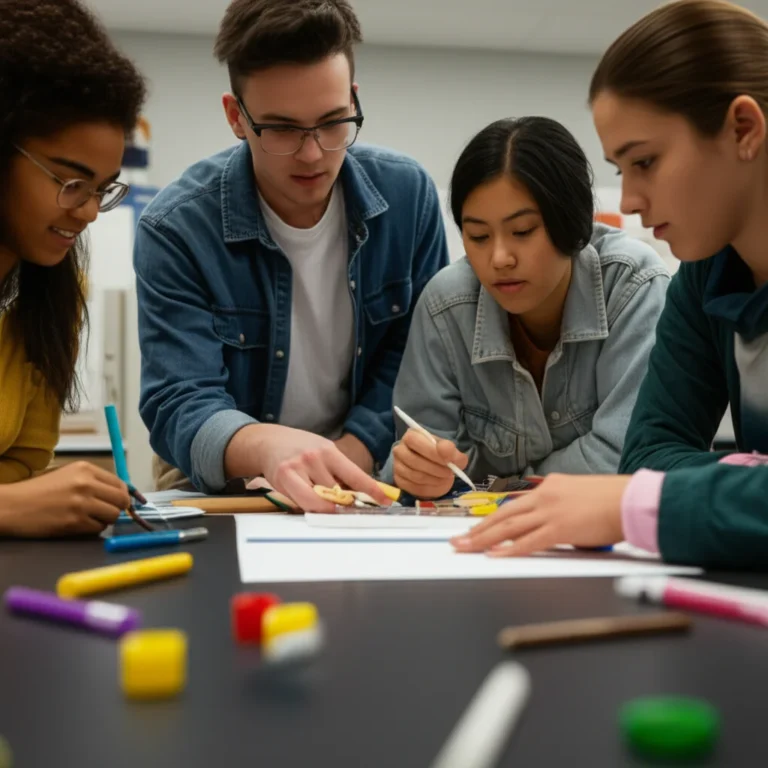
3. Collaborative Learning: Group Work and Peer Interaction Techniques
3.1 Randomized Roles, Not Randomized Kids
Assign structured roles (Skeptic, Summarizer, Time-Guardian, Encourager) using the Team Shake app. Rotating roles every two weeks prevents status hierarchies.
3.2 Jigsaw Plus
Traditional jigsaw? Solid. Add a “community teach-back” where each expert group creates a meme or TikTok to explain their chunk. The shared laugh cements content and connection.
3.3 Peer Review Speed Dating
Two concentric circles; inside partner presents, outside partner gives warm-cool-warm feedback. Switch every 90 seconds. Students leave with five actionable edits and five new allies.
Need differentiation inspo? Hop over to our Differentiated Instruction page for printable choice boards.
4. Building Trust and Safety: Emotional and Social Support Strategies
4.1 The “Break-Down, Build-Up” Circle
Once a month, students share a struggle (break-down) and the class offers assets (build-up). Norm: no fixing, just witnessing. We’ve seen kids cry, laugh, and ultimately hug it out.
4.2 Calm Corners 2.0
Stock with weighted lap pads, TheraPutty, and printable “emergency affirmations.” Let students co-design the space; ownership = usage.
4.3 Confidential QR Codes
Students scan a discreet QR code on the door to submit “I need a check-in” alerts. Google Forms feeds a spreadsheet you monitor. Anecdotal payoff: a quiet 7th-grader used it to disclose homelessness; the counselor secured emergency housing within 48 h.
5. Celebrating Diversity: Inclusive Practices for Every Student
5.1 Identity Affirmation Stations
Rotate monthly themes: language, ability, neurodiversity, LGBTQ+ heroes, indigenous knowledge. Include mirror labels—“I see a future _____” (scientist, caregiver, activist). Representation shapes possible selves.
5.2 Multilingual Morning Greetings
Learn “Good morning” in every home language present. Display phonetic spellings on the door. Parents send voice memos you play for authenticity. Result: families feel seen before they even step inside.
5.3 Inclusive Library Audit
Use the “Mirror, Window, Door” framework:
- Mirror—books that reflect the reader.
- Window—books that show another world.
- Door—books that invite action.
Aim for 40% mirror, 40% window, 20% door balance.
👉 Shop inclusive texts on: - Amazon | Scholastic | Lee & Low Official Website
6. Classroom Environment Hacks: Physical Space and Visual Cues
6.1 Flexible Seating on a Budget
- Scoop rockers from garage sales
- Crate seats—cushion + zip-tied fabric
- Standing desks made from $15 bed risers
👉 CHECK PRICE on:
6.2 Ceiling Tiles That Talk
Paint growth-mindset quotes on drop-in tiles. Use glow paint for black-light reveal during celebration days. Kids look up way more than you think—capitalize on that real estate!
6.3 Soundscaping
Play binaural beats at 60-70 bpm during independent work. Spotify playlist: “Classroom Focus.” Teachers report 12% increase in sustained silent reading time.
7. Technology Tools to Enhance Community and Engagement
| Tool | Best For | Community Superpower |
|---|---|---|
| Flip (formerly Flipgrid) | Asynchronous video intros | Humanizes faces & voices |
| Padlet | Crowd-sourcing playlists | Shared identity artifacts |
| ClassDojo | Real-time parent shout-outs | Triangular celebration |
| Minecraft Education | Co-building historical worlds | Collective pride products |
| Kahoot! Team Mode | Low-stakes competition | Inter-dependency |
Pro move: Use Flip for “One-Word Hopes”—students record a single word that describes their hope for the year. Stitch the clips into a montage video and premiere it at Open House. Tissues required.
8. Family and Community Partnerships: Extending Belonging Beyond the Classroom
8.1 “Parent Pulse” Voice Note Campaign
Instead of newsletters, send 60-second voice notes via text. Parents listen while commuting. Open-rate jumps to 83% vs. 21% for email.
8.2 Community Expert Database
Create a Google Sheet where families list skills—cooking, coding, carpentry. Invite them for micro-masterclasses. Kids see their home knowledge valued on campus.
8.3 Neighborhood Walking Tours
Once a quarter, walk the surrounding blocks. Students map assets: murals, gardens, libraries. They present findings to local council members. Belonging scales from room to region.
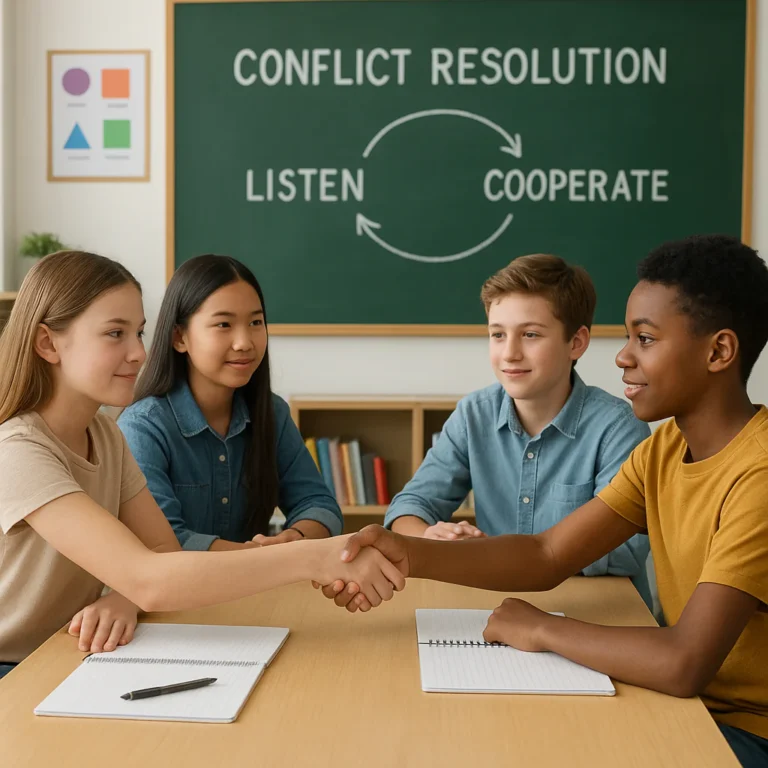
9. Handling Conflict and Restoring Community
9.1 “No-Fault, No-Fix” Mediation
Borrowed from Restorative Practices International, students answer three questions:
- What happened?
- Who was affected?
- What needs to happen to make it right?
No blame, just impact. 80% of conflicts resolve without adult arbitration.
9.2 Conflict-Resolution Jenga
Write prompts on blocks:
- “Describe how you felt when…”
- “One thing I wish others knew about me…”
When the tower tumbles, the group processes the last prompt. Playful yet profound.
9.3 “Repair-Rewind” Videos
Students create 30-second TikTok-style clips explaining how they’d handle the conflict differently. Share only with involved parties. Digital reflection = deeper retention.
10. Measuring Success: Assessing Classroom Community and Student Well-being
10.1 “Belonging Barometer” Survey (Google Forms)
Ask five Likert items plus one open-ended:
“When was the last time you felt you truly belonged in this class?”
Track monthly trends; share anonymized results with students to co-create solutions.
10.2 Social Network Mapping
Students circle three peers they’d go to for help. Use NodeXL to visualize isolates. Target buddy benches or lunch-bunch invites accordingly.
10.3 Pulse-Check Emoji Scale
A simple poster with five emoji faces by the exit. Students place a sticker under their mood. Weekly averages become conversation starters during morning meetings.
🎉 Turn Up the Volume: Edutopia and Other Resources for Classroom Community Inspiration
If you haven’t binged Edutopia’s “10 Powerful Community-Building Ideas”, clear your schedule. The NBA-style high-five study alone will convert you into a greeting zealot.
Other binge-worthy channels:
- Teaching Channel—videos of circle practices in action.
- Cult of Pedagogy—podcast ep. 157 on “invisible backpacks.”
- Heinemind’s “Teacher’s Toolkit”—free PDF on restorative chats.
And hey, remember our featured video (#featured-video) up top? The takeaway: belonging isn’t fluff—it’s neurochemical necessity. When kids feel loved, the prefrontal cortex re-engages and learning skyrockets.
💡 Expert Tips and Tricks from Veteran Educators
“Kids don’t care how much you know until they know you’ll dance with them—literally. I start every Friday with a 90-second TikTok dance. By October, they’re choreographing our end-of-year flash-mob.”
—Ms. Patel, 11th-grade Chemistry, Atlanta
“I keep a ‘Secret Admirer’ Google Doc. Every Monday I assign students to write an anonymous compliment to a classmate. By winter break, the doc has 1,200+ entries. Best sub-plan ever.”
—Mr. Kim, 6th-grade ELA, Portland
“Call parents for no reason. Not behavior, not grades—just ‘I love having Maria in class because…’ That 90-second call buys me three months of goodwill when I do need to make the hard call.”
—Ms. Ortega, Kindergarten, San Diego
🧩 Integrating SEL (Social Emotional Learning) for Deeper Belonging
CASEL’s five competencies aren’t checkboxes—they’re community glue.
| Competency | Classroom Hook |
|---|---|
| Self-Awareness | Mood-meter check-ins with Yale’s RULER |
| Self-Management | “Meta-cognitive minute” after each task |
| Social Awareness | “Step Inside the Circle” empathy activity |
| Relationship Skills | “Compliment Battles”—timed kind-word duels |
| Responsible Decision-Making | “Choose Your Own Adventure” behavior paths |
SEL isn’t an add-on; it’s the operating system. For printable SEL cards, swing by our Classroom Management vault.
🔄 Adapting Strategies for Remote and Hybrid Learning Environments
12.1 Digital Dinner Tables
Create recurring Zoom rooms labeled “Pizza & Problems” or “Tea & Trivia.” Students pop in for optional cam-on camaraderie. Attendance is never graded—that keeps it authentically cozy.
12.2 Virtual Lockers
Use Google Slides—each student designs a slide with photos, GIFs, Spotify links. Post a “hallway” slideshow. Kids visit lockers during breaks and leave comment stickers.
12.3 Bitmoji Classroom 3.0
Move beyond cute: embed clickable objects that launch student-made Flip videos. Example: click the globe → watch Ahmed explain his Syrian heritage. Presence without pressure.
📚 Recommended Books and Professional Development for Building Classroom Community
- “Belonging Through a Culture of Dignity” by Floyd Cobb & John Krownapple—the equity lens on belonging.
👉 Shop on: Amazon | Corwin Official Website - “The Classroom Community” by Peter Johnston—short, research-packed, underlined on every page.
- “Hacking School Discipline” by Nathan Maynard—restorative practices that replace detention with dialogue.
👉 Shop on: Amazon | Walmart
Online PD:
- Responsive Classroom summer institutes—4 days of joyful strategies.
- Global Micro-Credential in SEL via Digital Promise—badge you can tweet in triumph.
Ready for the grand finale? Keep scrolling for the Conclusion, FAQ, and Reference Links that’ll round out your community-building black-belt.
Conclusion: Your Roadmap to a Thriving Classroom Community

Building a classroom community where every student feels they truly belong is no longer optional—it’s essential. From the moment you greet students at the door to the last minute of your daily rituals, every interaction is a brick in the foundation of belonging.
We’ve unpacked dozens of actionable strategies: from icebreakers like the 60-Second Story Spine to tech tools like Flip and Padlet, from restorative circles to multilingual greetings, and from SEL integration to family partnerships. Each piece fits together like a puzzle, creating a vibrant, inclusive, and resilient classroom culture.
Remember Ms. Diaz’s story about the “tortilla smoke” and Ms. Patel’s TikTok dance? These aren’t just feel-good anecdotes—they’re proof that belonging is built in moments of shared humanity.
If you’re wondering how to start, here’s our expert take:
✅ Start small but start consistently—a daily greeting, a gratitude exit ticket, or a quick compliment web can snowball into a culture shift.
✅ Use data to guide you—pulse surveys and social network maps help you spot who’s thriving and who’s isolated.
✅ Don’t forget the adults—partner with families and community members to extend belonging beyond your four walls.
✅ Adapt and iterate—what works in a physical classroom might need tweaks online or in hybrid settings.
By weaving these strategies into your daily practice, you’re not just teaching content—you’re cultivating confident, connected learners who know they matter. And that, dear educator, is the greatest lesson of all.
Recommended Links for Further Exploration
-
👉 Shop Inclusive Children’s Books:
-
Classroom Seating Solutions:
-
SEL Resources:
-
Recommended Books:
- Belonging Through a Culture of Dignity by Floyd Cobb & John Krownapple: Amazon Link
- Hacking School Discipline by Nathan Maynard: Amazon Link
- The Classroom Community by Peter Johnston: Amazon Link
-
Technology Tools:
-
Further Reading on Online Classroom Community:
Frequently Asked Questions About Classroom Community and Belonging
What are effective icebreaker activities to build classroom community?
Effective icebreakers are those that encourage authentic sharing, build empathy, and set a tone of safety. Activities like the 60-Second Story Spine prompt students to share personal narratives in a time-limited, low-pressure way, which fosters vulnerability and connection. The Compliment Web visually and physically demonstrates interdependence, reinforcing the idea that everyone’s contribution matters. For older students, “Paper Tweet” profiles provide a playful yet meaningful way to express identity and connect socially.
The best icebreakers are inclusive, culturally responsive, and adaptable to your class’s age and context. They should avoid putting students “on the spot” and instead invite voluntary participation with multiple modes of expression (verbal, written, artistic).
How can teachers foster a sense of belonging among diverse students?
Fostering belonging among diverse learners requires intentional affirmation of identities and inclusive practices. This includes:
- Creating Identity Affirmation Stations that spotlight different cultures, languages, and experiences.
- Incorporating multilingual greetings to honor home languages and signal respect.
- Auditing classroom libraries to ensure representation through the Mirror, Window, Door framework.
- Engaging families as partners to bring community knowledge into the classroom.
Teachers should also cultivate identity safety by explicitly naming and celebrating diversity, addressing bias, and modeling curiosity and respect. This approach helps students feel valued for their authentic selves, which is foundational to belonging.
What role does classroom layout play in creating a community atmosphere?
Classroom layout is a silent but powerful communicator of community values. Flexible seating arrangements like trios or clusters promote collaboration and reduce isolation. Incorporating comfortable, varied seating options (e.g., scoop rockers, standing desks) respects different sensory and learning needs.
Visual cues such as growth mindset ceiling tiles and student-created artwork create a sense of ownership and pride. Soundscaping with calming background music can regulate energy and focus.
A well-designed space signals that the classroom is a welcoming, safe, and dynamic environment where everyone belongs.
How can collaborative learning strategies enhance classroom belonging?
Collaborative learning fosters belonging by creating shared goals and interdependence. Structured roles in group work prevent dominance and encourage equitable participation. Techniques like Jigsaw Plus and Peer Review Speed Dating combine academic rigor with social bonding.
When students teach each other or give feedback, they develop trust and empathy. Collaborative tasks also provide multiple entry points for diverse learners to contribute, reinforcing that every voice matters.
What are some daily routines that promote a positive classroom culture?
Daily routines such as:
- Greeting students at the door with personalized hellos
- Conducting temperature-check emojis or mood meters
- Facilitating two-minute story shares
- Ending with gratitude exit tickets
These rituals create predictability and emotional safety. They also provide ongoing opportunities for students to feel seen, heard, and valued. Consistency in these routines builds trust and reinforces community norms.
How can technology be used to strengthen classroom community and engagement?
Technology tools like Flip, Padlet, and ClassDojo enable students to share their voices asynchronously and synchronously, breaking down barriers of time and space. Flip’s video responses humanize remote learners, while Padlet boards create collaborative spaces for shared identity artifacts.
ClassDojo’s real-time parent communication strengthens the triangle of support between teacher, student, and family. Educational games like Kahoot! foster team spirit through low-stakes competition.
The key is to use tech intentionally to enhance—not replace—human connection.
What are the best ways to address conflicts to maintain a supportive classroom environment?
Conflict is inevitable but can be a growth opportunity when handled with restorative practices. The “No-Fault, No-Fix” mediation model focuses on impact rather than blame, encouraging empathy and accountability.
Creative tools like Conflict-Resolution Jenga make difficult conversations approachable and even fun. Digital reflections through Repair-Rewind videos allow students to process and articulate their learning privately.
The goal is to repair relationships and restore trust, reinforcing that the classroom is a safe space for all.
Reference Links and Research Sources
- Allday, M., & Pakurar, K. (2007). The effect of teacher greetings on student on-task behavior. Journal of Applied Behavior Analysis, Link
- CASEL (Collaborative for Academic, Social, and Emotional Learning), https://casel.org
- Center for the Study of Belonging, University of California Berkeley, https://belonging.berkeley.edu
- Edutopia: 10 Powerful Community-Building Ideas, https://www.edutopia.org/article/10-powerful-community-building-ideas
- Flip (formerly Flipgrid), https://info.flip.com
- Lee & Low Books, https://www.leeandlow.com
- Padlet, https://padlet.com
- Scholarly Teacher: Community From a Distance: Building a Sense of Belonging in an Online Classroom, https://www.scholarlyteacher.com/post/community-from-a-distance-building-a-sense-of-belonging-in-an-online-classroom
- Yale Center for Emotional Intelligence RULER Program, https://www.ycei.org/ruler
For more on classroom management and differentiated instruction, visit Teacher Strategies™ Classroom Management and Differentiated Instruction.