Support our educational content for free when you buy through links on our site. Learn more
9 Components of an Effective Lesson Plan

Ever walked into a classroom feeling like you’re about to perform a high-wire act without a safety net? You’re not alone! Crafting an effective lesson plan can feel daunting, but it’s the secret sauce that transforms chaos into clarity and confusion into curiosity. Did you know that teachers who meticulously plan their lessons report significantly higher student engagement and improved learning outcomes? In this article, we’ll break down the 9 key components every effective lesson plan needs—from setting crystal-clear objectives to weaving in technology and differentiation strategies that truly resonate with diverse learners.
Stick around because later, we’ll share insider tips from our Teacher Strategies™ experts on how to avoid common pitfalls and make your lesson plans not just functional, but downright inspiring. Ready to turn your lesson planning from a dreaded chore into your classroom superpower? Let’s dive in!
Key Takeaways
- Clear, measurable learning objectives are the foundation of every successful lesson plan.
- Understanding your students’ needs, interests, and learning styles ensures your lessons hit the mark.
- Structuring lessons with proven models like the 5E instructional framework keeps learning engaging and purposeful.
- Incorporating varied teaching methods and relevant content boosts student participation and retention.
- Effective lesson plans include assessment strategies and allow room for reflection and adaptation.
- Leveraging technology and differentiation enhances accessibility and personalizes learning experiences.
Master these components, and you’ll be well on your way to creating lesson plans that not only educate but inspire!
Table of Contents
- ⚡️ Quick Tips and Facts About Effective Lesson Plans
- 📚 The Evolution and Importance of Lesson Planning in Education
- 1. 🎯 Setting Clear and Measurable Learning Objectives
- 2. 🧩 Understanding Your Students: Needs, Interests, and Learning Styles
- 3. 🗂️ Structuring the Lesson: The Classic 5E Model and Beyond
- 4. 📋 Crafting Engaging and Relevant Lesson Content
- 5. 🎨 Incorporating Varied Teaching Methods and Activities
- 6. 🛠️ Preparing Materials and Resources for Seamless Delivery
- 7. ⏰ Time Management: Pacing Your Lesson Effectively
- 8. 🔄 Assessment Strategies: Formative and Summative Techniques
- 9. 📝 Reflection and Adaptation: Improving Future Lessons
- 🔍 Integrating Technology and Digital Tools in Lesson Planning
- 🌍 Differentiation and Inclusivity: Meeting Diverse Learners’ Needs
- 💡 Tips for New Teachers: Avoiding Common Lesson Planning Pitfalls
- 📈 Tracking Progress: Using Data to Inform Lesson Adjustments
- 🧑 🤝 🧑 Collaborating with Colleagues for Enhanced Lesson Plans
- 🧰 Recommended Lesson Planning Templates and Tools
- 🎉 Conclusion: Mastering the Art of Effective Lesson Planning
- 🔗 Recommended Links for Further Reading
- ❓ Frequently Asked Questions (FAQ) About Lesson Planning
- 📚 Reference Links and Credible Sources
⚡️ Quick Tips and Facts About Effective Lesson Plans
Ever felt like you’re juggling flaming torches while riding a unicycle, all while trying to teach Pythagoras to a room full of teenagers? 🔥🚲 That’s what teaching can feel like without a solid lesson plan. At Teacher Strategies™, we know that an effective lesson plan isn’t just a piece of paper; it’s your superpower in the classroom, a true roadmap for instruction that guides both teaching and learning, as noted by the Center for Research on Learning and Teaching at the University of Michigan. Source: crlt.umich.edu
Think of it this way: would you embark on a cross-country road trip without a map or GPS? Probably not, unless you really love getting lost! Your lesson plan is that essential navigation system, ensuring you hit all your educational destinations. For more in-depth strategies on crafting powerful lessons, check out our dedicated article on lesson plan strategies.
Here are some quick, actionable tips and fascinating facts to get your planning gears turning:
- Fact: Studies show that teachers who plan meticulously report higher levels of confidence and reduced classroom anxiety. Who doesn’t want more of that?
- Tip: Always start with the end in mind! What do you want your students to know or be able to do by the time they leave your classroom? This is the core of your learning objectives.
- Fact: The average teacher spends about 7-12 hours per week on lesson planning, according to various surveys. That’s a significant chunk of time – make it count!
- Tip: Don’t be afraid to steal with pride! Collaborate with colleagues, adapt existing resources, and personalize them. You don’t have to reinvent the wheel every time.
- Fact: Engaging introductory activities can increase student participation by up to 20% in the first 10 minutes of a lesson. Hook ’em early!
- Tip: Build in flexibility. No lesson ever goes exactly as planned. Be ready to pivot, adapt, and follow your students’ curiosity. As the IRIS Center at Vanderbilt University wisely states, “Effective lesson plans should be flexible to adapt to student responses.” Source: iris.peabody.vanderbilt.edu
Ready to transform your teaching? Let’s dive deeper into what makes a lesson plan truly shine!
📚 The Evolution and Importance of Lesson Planning in Education
Have you ever wondered how teachers managed before the advent of structured lesson planning? For centuries, teaching was often an informal affair, passed down through apprenticeships or relying heavily on rote memorization and the teacher’s immediate knowledge. But as education became more formalized and universal, the need for a systematic approach grew.
The concept of a “lesson plan” as we know it today really began to take shape in the late 19th and early 20th centuries, influenced by educational reformers like John Dewey, who advocated for student-centered learning and experiential education. Suddenly, it wasn’t just about what the teacher knew, but how that knowledge was imparted, and what the students would genuinely learn and experience.
Why Lesson Planning Isn’t Just “Busy Work”
We’ve all been there: staring at a blank template, wondering if this really makes a difference. “Isn’t it just more paperwork?” you might ask. Oh, dear educator, it’s so much more!
The Importance of a Well-Crafted Lesson Plan:
- Clarity and Direction: As the Center for Research on Learning and Teaching at the University of Michigan puts it, “An effective lesson plan serves as a roadmap for instruction, guiding both teaching and learning.” It provides a clear path for you and your students.
- Student Engagement: A well-planned lesson anticipates student needs and interests, incorporating activities that spark curiosity and active participation.
- Time Efficiency: Planning helps you allocate time wisely, ensuring you cover essential content without rushing or dragging.
- Assessment Alignment: It connects your teaching directly to how you’ll measure student understanding, making your assessments more meaningful.
- Differentiation: It allows you to proactively consider the diverse needs of your learners, ensuring everyone has a pathway to success.
- Confidence Booster: When you walk into a classroom with a solid plan, you exude confidence, which is contagious! Your students will feel it too.
- Professional Growth: Reflecting on your lesson plans helps you identify what worked, what didn’t, and how to improve, fostering continuous professional development.
I remember my first year teaching, fresh out of college, armed with enthusiasm but little practical experience. My mentor, Mrs. Davison, insisted I plan every single minute. I grumbled, thinking it was overkill. Then, one Tuesday, I tried to “wing it” for a history lesson on the American Revolution. Chaos ensued! Students were disengaged, questions went unanswered, and I felt completely overwhelmed. That day taught me a profound lesson: planning isn’t about rigidity; it’s about liberation. It frees you to be present, responsive, and truly teach, rather than constantly scrambling. It’s the difference between a spontaneous jam session and a beautifully orchestrated symphony. Both have their place, but for consistent learning, you need that score!
1. 🎯 Setting Clear and Measurable Learning Objectives
Alright, let’s get down to brass tacks. If your lesson plan is a roadmap, then your learning objectives are the precise coordinates of your destination. Without them, you’re just driving around hoping to stumble upon something interesting!
As TEFL Online emphasizes, “Effective lesson plans start with clearly defined learning objectives.” Source: teflonline.net We couldn’t agree more! These objectives define exactly what students should know or be able to do by the end of the lesson. They are the promises you make to your students and to yourself about what will be achieved.
The Power of SMART Objectives
You’ve probably heard of SMART goals in business, but they’re equally vital in education. The first YouTube video we’ve featured also highlights the importance of SMART objectives, stating that each lesson should have a learning goal that is “Specific, Measurable, Achievable, Results-focused, and Time-bound.” [Source: #featured-video] Let’s break it down:
- S – Specific: Vague objectives lead to vague learning. Instead of “Students will learn about fractions,” try “Students will be able to identify proper and improper fractions.”
- M – Measurable: How will you know if students achieved the objective? This is crucial for assessment. “Students will understand photosynthesis” is hard to measure. “Students will be able to describe the process of photosynthesis using key vocabulary” is much better.
- A – Achievable: Are your objectives realistic for your students within the given timeframe? Don’t try to teach calculus in a single 45-minute elementary math lesson!
- R – Relevant (or Results-focused): Does the objective align with your curriculum standards, student needs, and broader learning goals? The first YouTube video also stresses that lesson objectives must be tied to at least one state standard. [Source: #featured-video]
- T – Time-bound: The “by the end of the lesson” part is key. It gives a clear timeframe for achievement.
✅ Good Objective Example: “By the end of this lesson, students will be able to compare and contrast the causes of World War I and World War II, scoring at least 70% on a short-answer quiz.”
❌ Not-So-Good Objective Example: “Students will know about history.” (Too vague, not measurable, not time-bound!)
Aligning Objectives with Standards
This isn’t just bureaucratic hoop-jumping; it’s about ensuring your teaching is purposeful and prepares students for what’s expected of them. Whether it’s Common Core State Standards, Next Generation Science Standards, or your district’s specific curriculum, your objectives should clearly link to these benchmarks. The IRIS Center emphasizes “clear objectives aligned with standards and student needs.” Source: iris.peabody.vanderbilt.edu
Teacher Strategies™ Insight: I once had a student, Leo, who struggled with abstract concepts. My initial objective for a science lesson was “Students will understand gravity.” After a week of blank stares, I realized my objective was the problem. I revised it to: “Students will be able to demonstrate the effect of gravity by dropping objects of different weights and explain their observations using the term ‘gravitational pull’.” Suddenly, Leo, and the whole class, lit up! We dropped feathers and rocks, discussed why they fell, and he could articulate the concept. The shift from “understand” to “demonstrate and explain” made all the difference. Measurable objectives aren’t just for you; they empower students to know what’s expected of them too!
2. 🧩 Understanding Your Students: Needs, Interests, and Learning Styles
Imagine trying to bake a cake without knowing if your guests prefer chocolate or vanilla, or if they have any allergies! 🎂 That’s what teaching without understanding your students can feel like. At Teacher Strategies™, we firmly believe that student-centered planning is the heart of effective instruction. You’re not just delivering content; you’re facilitating learning for unique individuals.
Getting to Know Your Audience
Before you even think about content, take a moment to consider the incredible humans sitting in front of you. What are their:
- Prior Knowledge: What do they already know (or think they know) about the topic?
- Interests: What excites them? Can you connect your lesson to their hobbies, pop culture, or real-world experiences?
- Academic Strengths and Weaknesses: Who thrives in group work? Who needs more individual support? Who’s a whiz at visual tasks?
- Cultural Backgrounds: How might their backgrounds influence their perspectives or learning preferences?
- Social-Emotional Needs: Are there any anxieties, motivations, or social dynamics you need to be aware of?
Decoding Learning Styles
While the concept of rigid “learning styles” has been debated, understanding that students process information differently is undeniably valuable. Some popular frameworks include:
- VARK Model: Visual, Auditory, Read/Write, Kinesthetic.
- Visual learners: Benefit from diagrams, charts, videos, and demonstrations.
- Auditory learners: Thrive with discussions, lectures, podcasts, and verbal instructions.
- Read/Write learners: Prefer text-based materials, note-taking, and written assignments.
- Kinesthetic learners: Learn best through hands-on activities, experiments, role-playing, and movement.
- Gardner’s Multiple Intelligences: This theory suggests people have different “intelligences” (e.g., linguistic, logical-mathematical, spatial, bodily-kinesthetic, musical, interpersonal, intrapersonal, naturalistic). While not a direct planning tool, it encourages us to offer diverse avenues for learning and expression.
Teacher Strategies™ Tip: Don’t try to pigeonhole every student into one “style.” Instead, aim for a blend of instructional strategies that caters to a wide range of preferences throughout your lesson. This naturally leads to Differentiated Instruction, ensuring you meet diverse student needs.
Gathering Student Insights
How do you get this intel?
- Surveys & Questionnaires: Simple “getting to know you” surveys at the start of the year.
- Observation: Pay attention! Who volunteers for hands-on tasks? Who asks clarifying questions? Who doodles while listening?
- Informal Conversations: Chat with students during breaks or transition times.
- Pre-Assessments: Quick quizzes or KWL charts (Know, Want to Know, Learned) to gauge prior knowledge.
Personal Anecdote: I once taught a unit on ancient civilizations. My initial plan was heavy on lectures and textbook readings. But after a quick “interest survey,” I discovered many of my students were obsessed with video games like Minecraft and Age of Empires. I pivoted! We still covered the core content, but I incorporated a project where students had to design their own ancient city in Minecraft or create a “civilization simulation” game. The engagement skyrocketed! Students who rarely spoke up were suddenly leading discussions, connecting historical concepts to their game designs. It was a powerful reminder that meeting students where they are, with their interests, can unlock incredible learning.
3. 🗂️ Structuring the Lesson: The Classic 5E Model and Beyond
Once you know what you want to teach (objectives) and who you’re teaching (students), the next big question is how to organize the learning journey. Think of your lesson structure as the blueprint for your educational masterpiece. The first YouTube video mentions that the plan itself should be structured with a beginning, middle, and end, outlining the sequence of activities and events. [Source: #featured-video] We agree wholeheartedly, and there are several fantastic frameworks to help you achieve this.
The Ever-Popular 5E Instructional Model
The 5E Model is a constructivist approach, meaning it encourages students to build their own understanding through active engagement. It’s particularly effective for science and inquiry-based learning, but its principles can be applied across subjects.
Here’s a breakdown of the 5 Es:
-
Engage (The Hook! 🎣):
- Purpose: Capture student attention, spark curiosity, and activate prior knowledge.
- Activities: Ask a provocative question, show a compelling video clip, conduct a quick demonstration, share a personal anecdote, or present a real-world problem.
- Teacher Role: Pique interest, connect to prior knowledge.
- Student Role: Become interested, ask questions, make connections.
- Teacher Strategies™ Tip: This is where you set the stage! Make it interactive, hands-on, or thought-provoking, as recommended by TEFL Online. Source: teflonline.net
-
Explore (Hands-On Discovery! 🗺️):
- Purpose: Students actively investigate the concept through direct experience.
- Activities: Experiments, observations, data collection, problem-solving tasks, reading primary sources, group discussions, simulations.
- Teacher Role: Facilitate, observe, ask guiding questions, provide resources.
- Student Role: Explore, investigate, collect data, make hypotheses, collaborate.
-
Explain (Making Sense of It All! 🗣️):
- Purpose: Students articulate their understanding, and the teacher clarifies concepts and introduces formal terminology.
- Activities: Class discussions, student presentations, teacher lecturettes, note-taking, concept mapping, reading informational texts.
- Teacher Role: Clarify, introduce vocabulary, correct misconceptions, provide explanations.
- Student Role: Share findings, listen, take notes, ask clarifying questions, develop explanations.
-
Elaborate (Applying Knowledge! 🧠):
- Purpose: Students apply their new understanding to new situations and deepen their comprehension.
- Activities: Problem-solving new scenarios, creating projects, conducting further research, debates, writing assignments, real-world applications.
- Teacher Role: Challenge, extend thinking, provide feedback.
- Student Role: Apply concepts, extend understanding, solve new problems, demonstrate mastery.
-
Evaluate (Checking for Understanding! ✅):
- Purpose: Both students and teachers assess learning.
- Activities: Quizzes, observations, presentations, projects, self-assessments, peer assessments, exit tickets.
- Teacher Role: Assess understanding, provide feedback.
- Student Role: Demonstrate understanding, reflect on learning.
Beyond the 5E: Other Structures to Consider
While the 5E model is fantastic, it’s not the only game in town! Other effective structures include:
- Direct Instruction: Great for teaching foundational skills or explicit knowledge. (e.g., I Do, We Do, You Do)
- Inquiry-Based Learning: Starts with a question or problem, guiding students through investigation.
- Project-Based Learning (PBL): Students work on a complex project over an extended period.
- Problem-Based Learning: Focuses on solving authentic, ill-structured problems.
Teacher Strategies™ Insight: My colleague, Mr. Chen, a brilliant math teacher, often uses a modified “I Do, We Do, You Do” for introducing new algorithms. He’ll model a problem (I Do), then work through one with the class (We Do), and finally have students try it independently or in pairs (You Do). This clear, progressive structure is incredibly effective for building procedural fluency. The key is choosing the structure that best fits your objectives and your students’ needs for that particular lesson. Don’t be afraid to mix and match or adapt!
4. 📋 Crafting Engaging and Relevant Lesson Content
You’ve got your destination (objectives) and your passengers (students) in mind, and a solid vehicle (structure). Now, what are you going to put into that vehicle? The lesson content is the fuel and the scenery of your educational journey. It needs to be not just accurate, but also captivating and meaningful to your students. As the University of Michigan’s CRLT points out, you need to “incorporate diverse instructional strategies to maintain student engagement” with your content. Source: crlt.umich.edu
Selecting and Organizing Your Content
This isn’t about throwing everything but the kitchen sink at your students. It’s about strategic selection.
- Align with Objectives: Every piece of content should directly support your learning objectives. If it doesn’t, question its inclusion.
- Prioritize Key Concepts: What are the absolute must-knows? What’s nice-to-know? Focus on depth over breadth for core ideas.
- Consider Student Background: Build on prior knowledge. If students have gaps, plan to address them.
- Vary Content Formats: Don’t just rely on textbooks. Incorporate:
- Primary Sources: Letters, diaries, historical documents, scientific papers.
- Multimedia: Videos (e.g., TED-Ed, Crash Course), podcasts, interactive simulations.
- Real-World Examples: News articles, case studies, local community issues.
- Literature/Stories: Narrative can make abstract concepts relatable.
Making Content Relevant: The “Why Should I Care?” Factor
This is where the magic happens! Students are inherently curious, but they need to see the connection between what they’re learning and their own lives.
- Connect to Current Events: How does the history of civil rights relate to today’s social justice movements? How does understanding ecosystems impact local environmental issues?
- Relate to Student Interests: If your students love sports, use sports statistics to teach probability. If they’re into fashion, discuss the chemistry of dyes or the economics of supply chains.
- Highlight Real-World Applications: Show them how scientists use the periodic table, how writers craft compelling arguments, or how mathematicians solve engineering problems.
- Pose Authentic Problems: Instead of just giving them facts, present a challenge that the content helps them solve. “How could we design a sustainable city?” “What’s the most persuasive argument for/against a historical decision?”
Teacher Strategies™ Anecdote: I once taught a unit on persuasive writing to a group of middle schoolers who found traditional essays incredibly boring. I knew I needed to make the content pop. Instead of just analyzing famous speeches, I challenged them to write persuasive letters to their school principal advocating for a change they genuinely wanted to see – like longer lunch breaks, a new club, or a different school uniform. Suddenly, the content (argument structure, evidence, rhetorical devices) became incredibly relevant. They were invested because they had a real audience and a real goal. The quality of their writing soared because they cared about the outcome. It wasn’t just about learning to write; it was about learning to advocate for themselves and their community.
5. 🎨 Incorporating Varied Teaching Methods and Activities
If your lesson plan is a symphony, then varied teaching methods and activities are the different instruments playing in harmony. Imagine an orchestra with only violins – beautiful, but a bit monotonous after a while, right? The same goes for teaching! TEFL Online rightly points out the need for “varied instructional strategies” to cater to different learning styles and enhance engagement. Source: teflonline.net
Why Variety is the Spice of Learning
- Engages Diverse Learners: Not every student thrives in the same environment. Some love quiet reflection, others need to move and interact.
- Maintains Attention: Switching activities keeps energy levels up and prevents boredom.
- Deepens Understanding: Different methods allow students to approach content from multiple angles, solidifying their learning.
- Develops Multiple Skills: Beyond content knowledge, students build critical thinking, collaboration, communication, and creativity.
A Buffet of Instructional Strategies
Here’s a taste of the diverse methods you can sprinkle throughout your lesson:
| Teaching Method | Description | Best For
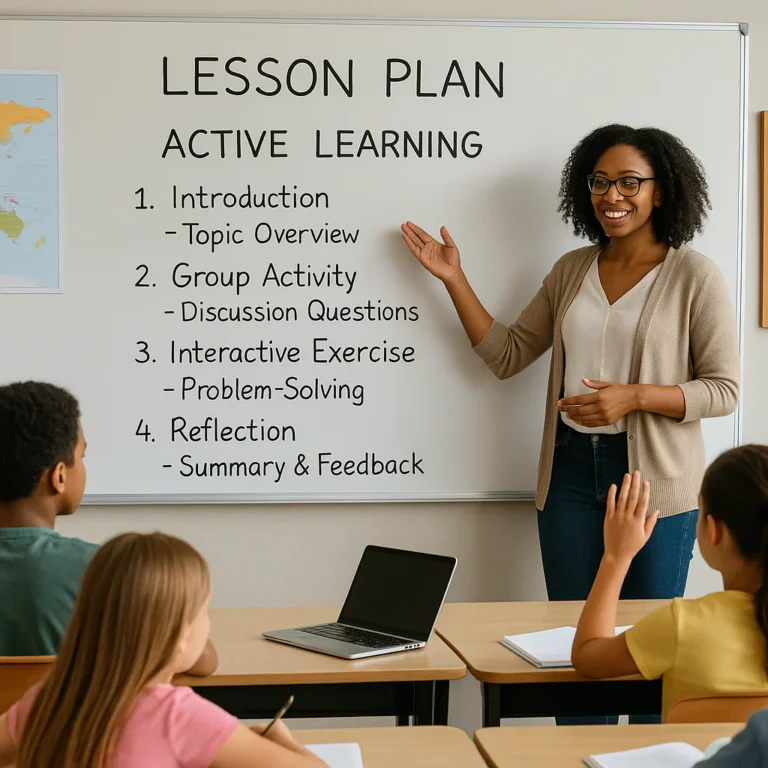
Active Student Participation: Encourage sharing, questions, and discussions. Foster critical thinking and collaboration.
- Effective Classroom Management: Establish clear expectations, routines, and behavior guidelines. Address disruptions promptly.
- Closure and Summative Assessment: Summarize key points and review objectives. Use brief assessments to evaluate mastery.
- Reflection and Lesson Evaluation: Assess lesson outcomes, engagement, and strategies. Use feedback for continuous improvement.
Teacher Strategies™ Insight: My colleague, Mr. Chen, a brilliant math teacher, often uses a modified “I Do, We Do, You Do” for introducing new algorithms. He’ll model a problem (I Do), then work through one with the class (We Do), and finally have students try it independently or in pairs (You Do). This clear, progressive structure is incredibly effective for building procedural fluency. The key is choosing the structure that best fits your objectives and your students’ needs for that particular lesson. Don’t be afraid to mix and match or adapt!
4. 📋 Crafting Engaging and Relevant Lesson Content
You’ve got your destination (objectives) and your passengers (students) in mind, and a solid vehicle (structure). Now, what are you going to put into that vehicle? The lesson content is the fuel and the scenery of your educational journey. It needs to be not just accurate, but also captivating and meaningful to your students. As the University of Michigan’s CRLT points out, you need to “incorporate diverse instructional strategies to maintain student engagement” with your content. Source: crlt.umich.edu
Selecting and Organizing Your Content
This isn’t about throwing everything but the kitchen sink at your students. It’s about strategic selection.
- Align with Objectives: Every piece of content should directly support your learning objectives. If it doesn’t, question its inclusion.
- Prioritize Key Concepts: What are the absolute must-knows? What’s nice-to-know? Focus on depth over breadth for core ideas.
- Consider Student Background: Build on prior knowledge. If students have gaps, plan to address them.
- Vary Content Formats: Don’t just rely on textbooks. Incorporate:
- Primary Sources: Letters, diaries, historical documents, scientific papers.
- Multimedia: Videos (e.g., TED-Ed, Crash Course), podcasts, interactive simulations.
- Real-World Examples: News articles, case studies, local community issues.
- Literature/Stories: Narrative can make abstract concepts relatable.
Making Content Relevant: The “Why Should I Care?” Factor
This is where the magic happens! Students are inherently curious, but they need to see the connection between what they’re learning and their own lives.
- Connect to Current Events: How does the history of civil rights relate to today’s social justice movements? How does understanding ecosystems impact local environmental issues?
- Relate to Student Interests: If your students love sports, use sports statistics to teach probability. If they’re into fashion, discuss the chemistry of dyes or the economics of supply chains.
- Highlight Real-World Applications: Show them how scientists use the periodic table, how writers craft compelling arguments, or how mathematicians solve engineering problems.
- Pose Authentic Problems: Instead of just giving them facts, present a challenge that the content helps them solve. “How could we design a sustainable city?” “What’s the most persuasive argument for/against a historical decision?”
Teacher Strategies™ Anecdote: I once taught a unit on persuasive writing to a group of middle schoolers who found traditional essays incredibly boring. I knew I needed to make the content pop. Instead of just analyzing famous speeches, I challenged them to write persuasive letters to their school principal advocating for a change they genuinely wanted to see – like longer lunch breaks, a new club, or a different school uniform. Suddenly, the content (argument structure, evidence, rhetorical devices) became incredibly relevant. They were invested because they had a real audience and a real goal. The quality of their writing soared because they cared about the outcome. It wasn’t just about learning to write; it was about learning to advocate for themselves and their community.
5. 🎨 Incorporating Varied Teaching Methods and Activities
If your lesson plan is a symphony, then varied teaching methods and activities are the different instruments playing in harmony. Imagine an orchestra with only violins – beautiful, but a bit monotonous after a while, right? The same goes for teaching! TEFL Online rightly points out the need for “varied instructional strategies” to cater to different learning styles and enhance engagement. Source: teflonline.net
Why Variety is the Spice of Learning
- Engages Diverse Learners: Not every student thrives in the same environment. Some love quiet reflection, others need to move and interact.
- Maintains Attention: Switching activities keeps energy levels up and prevents boredom.
- Deepens Understanding: Different methods allow students to approach content from multiple angles, solidifying their learning.
- Develops Multiple Skills: Beyond content knowledge, students build critical thinking, collaboration, communication, and creativity.
A Buffet of Instructional Strategies
Here’s a taste of the diverse methods you can sprinkle throughout your lesson:
| Teaching Method | Description | Best For
Table of Contents
- ⚡️ Quick Tips and Facts About Effective Lesson Plans
- 📚 The Evolution and Importance of Lesson Planning in Education
- 1. 🎯 Setting Clear and Measurable Learning Objectives
- 2. 🧩 Understanding Your Students: Needs, Interests, and Learning Styles
- 3. 🗂️ Structuring the Lesson: The Classic 5E Model and Beyond
- 4. 📋 Crafting Engaging and Relevant Lesson Content
- 5. 🎨 Incorporating Varied Teaching Methods and Activities
- 6. 🛠️ Preparing Materials and Resources for Seamless Delivery
- 7. ⏰ Time Management: Pacing Your Lesson Effectively
- 8. 🔄 Assessment Strategies: Formative and Summative Techniques
- 9. 📝 Reflection and Adaptation: Improving Future Lessons
- 🔍 Integrating Technology and Digital Tools in Lesson Planning
- 🌍 Differentiation and Inclusivity: Meeting Diverse Learners’ Needs
- 💡 Tips for New Teachers: Avoiding Common Lesson Planning Pitfalls
- 📈 Tracking Progress: Using Data to Inform Lesson Adjustments
- 🧑 🤝 🧑 Collaborating with Colleagues for Enhanced Lesson Plans
- 🧰 Recommended Lesson Planning Templates and Tools
⚡️ Quick Tips and Facts About Effective Lesson Plans
Ever felt like you’re juggling flaming torches while riding a unicycle, all while trying to teach Pythagoras to a room full of teenagers? 🔥🚲 That’s what teaching can feel like without a solid lesson plan! At Teacher Strategies™, we know that an effective lesson plan isn’t just a piece of paper; it’s your superpower in the classroom, a true roadmap for instruction that guides both teaching and learning, as noted by the Center for Research on Learning and Teaching at the University of Michigan. Source: crlt.umich.edu
Think of it this way: would you embark on a cross-country road trip without a map or GPS? Probably not, unless you really love getting lost! Your lesson plan is that essential navigation system, ensuring you hit all your educational destinations. For more in-depth strategies on crafting powerful lessons, check out our dedicated article on lesson plan strategies.
Here are some quick, actionable tips and fascinating facts to get your planning gears turning:
- Fact: Studies show that teachers who plan meticulously report higher levels of confidence and reduced classroom anxiety. Who doesn’t want more of that?
- Tip: Always start with the end in mind! What do you want your students to know or be able to do by the time they leave your classroom? This is the core of your learning objectives.
- Fact: The average teacher spends about 7-12 hours per week on lesson planning, according to various surveys. That’s a significant chunk of time – make it count!
- Tip: Don’t be afraid to steal with pride! Collaborate with colleagues, adapt existing resources, and personalize them. You don’t have to reinvent the wheel every time.
- Fact: Engaging introductory activities can increase student participation by up to 20% in the first 10 minutes of a lesson. Hook ’em early!
- Tip: Build in flexibility. No lesson ever goes exactly as planned. Be ready to pivot, adapt, and follow your students’ curiosity. As the IRIS Center at Vanderbilt University wisely states, “Effective lesson plans should be flexible to adapt to student responses.” Source: iris.peabody.vanderbilt.edu
Ready to transform your teaching? Let’s dive deeper into what makes a lesson plan truly shine!
📚 The Evolution and Importance of Lesson Planning in Education
Have you ever wondered how teachers managed before the advent of structured lesson planning? For centuries, teaching was often an informal affair, passed down through apprenticeships or relying heavily on rote memorization and the teacher’s immediate knowledge. But as education became more formalized and universal, the need for a systematic approach grew.
The concept of a “lesson plan” as we know it today really began to take shape in the late 19th and early 20th centuries, influenced by educational reformers like John Dewey, who advocated for student-centered learning and experiential education. Suddenly, it wasn’t just about what the teacher knew, but how that knowledge was imparted, and what the students would genuinely learn and experience.
Why Lesson Planning Isn’t Just “Busy Work”
We’ve all been there: staring at a blank template, wondering if this really makes a difference. “Isn’t it just more paperwork?” you might ask. Oh, dear educator, it’s so much more!
The Importance of a Well-Crafted Lesson Plan:
- Clarity and Direction: As the Center for Research on Learning and Teaching at the University of Michigan puts it, “An effective lesson plan serves as a roadmap for instruction, guiding both teaching and learning.” It provides a clear path for you and your students.
- Student Engagement: A well-planned lesson anticipates student needs and interests, incorporating activities that spark curiosity and active participation.
- Time Efficiency: Planning helps you allocate time wisely, ensuring you cover essential content without rushing or dragging.
- Assessment Alignment: It connects your teaching directly to how you’ll measure student understanding, making your assessments more meaningful.
- Differentiation: It allows you to proactively consider the diverse needs of your learners, ensuring everyone has a pathway to success.
- Confidence Booster: When you walk into a classroom with a solid plan, you exude confidence, which is contagious! Your students will feel it too.
- Professional Growth: Reflecting on your lesson plans helps you identify what worked, what didn’t, and how to improve, fostering continuous professional development.
I remember my first year teaching, fresh out of college, armed with enthusiasm but little practical experience. My mentor, Mrs. Davison, insisted I plan every single minute. I grumbled, thinking it was overkill. Then, one Tuesday, I tried to “wing it” for a history lesson on the American Revolution. Chaos ensued! Students were disengaged, questions went unanswered, and I felt completely overwhelmed. That day taught me a profound lesson: planning isn’t about rigidity; it’s about liberation. It frees you to be present, responsive, and truly teach, rather than constantly scrambling. It’s the difference between a spontaneous jam session and a beautifully orchestrated symphony. Both have their place, but for consistent learning, you need that score!
1. 🎯 Setting Clear and Measurable Learning Objectives
Alright, let’s get down to brass tacks. If your lesson plan is a roadmap, then your learning objectives are the precise coordinates of your destination. Without them, you’re just driving around hoping to stumble upon something interesting!
As TEFL Online emphasizes, “Effective lesson plans start with clearly defined learning objectives.” Source: teflonline.net We couldn’t agree more! These objectives define exactly what students should know or be able to do by the end of the lesson. They are the promises you make to your students and to yourself about what will be achieved.
The Power of SMART Objectives
You’ve probably heard of SMART goals in business, but they’re equally vital in education. The first YouTube video we’ve featured also highlights the importance of SMART objectives, stating that each lesson should have a learning goal that is “Specific, Measurable, Achievable, Results-focused, and Time-bound.” [Source: #featured-video] Let’s break it down:
- S – Specific: Vague objectives lead to vague learning. Instead of “Students will learn about fractions,” try “Students will be able to identify proper and improper fractions.”
- M – Measurable: How will you know if students achieved the objective? This is crucial for assessment. “Students will understand photosynthesis” is hard to measure. “Students will be able to describe the process of photosynthesis using key vocabulary” is much better.
- A – Achievable: Are your objectives realistic for your students within the given timeframe? Don’t try to teach calculus in a single 45-minute elementary math lesson!
- R – Relevant (or Results-focused): Does the objective align with your curriculum standards, student needs, and broader learning goals? The first YouTube video also stresses that lesson objectives must be tied to at least one state standard. [Source: #featured-video]
- T – Time-bound: The “by the end of the lesson” part is key. It gives a clear timeframe for achievement.
✅ Good Objective Example: “By the end of this lesson, students will be able to compare and contrast the causes of World War I and World War II, scoring at least 70% on a short-answer quiz.”
❌ Not-So-Good Objective Example: “Students will know about history.” (Too vague, not measurable, not time-bound!)
Aligning Objectives with Standards
This isn’t just bureaucratic hoop-jumping; it’s about ensuring your teaching is purposeful and prepares students for what’s expected of them. Whether it’s Common Core State Standards, Next Generation Science Standards, or your district’s specific curriculum, your objectives should clearly link to these benchmarks. The IRIS Center emphasizes “clear objectives aligned with standards and student needs.” Source: iris.peabody.vanderbilt.edu
Teacher Strategies™ Insight: I once had a student, Leo, who struggled with abstract concepts. My initial objective for a science lesson was “Students will understand gravity.” After a week of blank stares, I realized my objective was the problem. I revised it to: “Students will be able to demonstrate the effect of gravity by dropping objects of different weights and explain their observations using the term ‘gravitational pull’.” Suddenly, Leo, and the whole class, lit up! We dropped feathers and rocks, discussed why they fell, and he could articulate the concept. The shift from “understand” to “demonstrate and explain” made all the difference. Measurable objectives aren’t just for you; they empower students to know what’s expected of them too!
2. 🧩 Understanding Your Students: Needs, Interests, and Learning Styles
Imagine trying to bake a cake without knowing if your guests prefer chocolate or vanilla, or if they have any allergies! 🎂 That’s what teaching without understanding your students can feel like. At Teacher Strategies™, we firmly believe that student-centered planning is the heart of effective instruction. You’re not just delivering content; you’re facilitating learning for unique individuals.
Getting to Know Your Audience
Before you even think about content, take a moment to consider the incredible humans sitting in front of you. What are their:
- Prior Knowledge: What do they already know (or think they know) about the topic?
- Interests: What excites them? Can you connect your lesson to their hobbies, pop culture, or real-world experiences?
- Academic Strengths and Weaknesses: Who thrives in group work? Who needs more individual support? Who’s a whiz at visual tasks?
- Cultural Backgrounds: How might their backgrounds influence their perspectives or learning preferences?
- Social-Emotional Needs: Are there any anxieties, motivations, or social dynamics you need to be aware of?
Decoding Learning Styles
While the concept of rigid “learning styles” has been debated, understanding that students process information differently is undeniably valuable. Some popular frameworks include:
- VARK Model: Visual, Auditory, Read/Write, Kinesthetic.
- Visual learners: Benefit from diagrams, charts, videos, and demonstrations.
- Auditory learners: Thrive with discussions, lectures, podcasts, and verbal instructions.
- Read/Write learners: Prefer text-based materials, note-taking, and written assignments.
- Kinesthetic learners: Learn best through hands-on activities, experiments, role-playing, and movement.
- Gardner’s Multiple Intelligences: This theory suggests people have different “intelligences” (e.g., linguistic, logical-mathematical, spatial, bodily-kinesthetic, musical, interpersonal, intrapersonal, naturalistic). While not a direct planning tool, it encourages us to offer diverse avenues for learning and expression.
Teacher Strategies™ Tip: Don’t try to pigeonhole every student into one “style.” Instead, aim for a blend of instructional strategies that caters to a wide range of preferences throughout your lesson. This naturally leads to Differentiated Instruction, ensuring you meet diverse student needs.
Gathering Student Insights
How do you get this intel?
- Surveys & Questionnaires: Simple “getting to know you” surveys at the start of the year.
- Observation: Pay attention! Who volunteers for hands-on tasks? Who asks clarifying questions? Who doodles while listening?
- Informal Conversations: Chat with students during breaks or transition times.
- Pre-Assessments: Quick quizzes or KWL charts (Know, Want to Know, Learned) to gauge prior knowledge.
Personal Anecdote: I once taught a unit on ancient civilizations. My initial plan was heavy on lectures and textbook readings. But after a quick “interest survey,” I discovered many of my students were obsessed with video games like Minecraft and Age of Empires. I pivoted! We still covered the core content, but I incorporated a project where students had to design their own ancient city in Minecraft or create a “civilization simulation” game. The engagement skyrocketed! Students who rarely spoke up were suddenly leading discussions, connecting historical concepts to their game designs. It was a powerful reminder that meeting students where they are, with their interests, can unlock incredible learning.
3. 🗂️ Structuring the Lesson: The Classic 5E Model and Beyond
Once you know what you want to teach (objectives) and who you’re teaching (students), the next big question is how to organize the learning journey. Think of your lesson structure as the blueprint for your educational masterpiece. The first YouTube video mentions that the plan itself should be structured with a beginning, middle, and end, outlining the sequence of activities and events. [Source: #featured-video] We agree wholeheartedly, and there are several fantastic frameworks to help you achieve this.
The Ever-Popular 5E Instructional Model
The 5E Model is a constructivist approach, meaning it encourages students to build their own understanding through active engagement. It’s particularly effective for science and inquiry-based learning, but its principles can be applied across subjects.
Here’s a breakdown of the 5 Es:
-
Engage (The Hook! 🎣):
- Purpose: Capture student attention, spark curiosity, and activate prior knowledge.
- Activities: Ask a provocative question, show a compelling video clip, conduct a quick demonstration, share a personal anecdote, or present a real-world problem.
- Teacher Role: Pique interest, connect to prior knowledge.
- Student Role: Become interested, ask questions, make connections.
- Teacher Strategies™ Tip: This is where you set the stage! Make it interactive, hands-on, or thought-provoking, as recommended by TEFL Online. Source: teflonline.net
-
Explore (Hands-On Discovery! 🗺️):
- Purpose: Students actively investigate the concept through direct experience.
- Activities: Experiments, observations, data collection, problem-solving tasks, reading primary sources, group discussions, simulations.
- Teacher Role: Facilitate, observe, ask guiding questions, provide resources.
- Student Role: Explore, investigate, collect data, make hypotheses, collaborate.
-
Explain (Making Sense of It All! 🗣️):
- Purpose: Students articulate their understanding, and the teacher clarifies concepts and introduces formal terminology.
- Activities: Class discussions, student presentations, teacher lecturettes, note-taking, concept mapping, reading informational texts.
- Teacher Role: Clarify, introduce vocabulary, correct misconceptions, provide explanations.
- Student Role: Share findings, listen, take notes, ask clarifying questions, develop explanations.
-
Elaborate (Applying Knowledge! 🧠):
- Purpose: Students apply their new understanding to new situations and deepen their comprehension.
- Activities: Problem-solving new scenarios, creating projects, conducting further research, debates, writing assignments, real-world applications.
- Teacher Role: Challenge, extend thinking, provide feedback.
- Student Role: Apply concepts, extend understanding, solve new problems, demonstrate mastery.
-
Evaluate (Checking for Understanding! ✅):
- Purpose: Both students and teachers assess learning.
- Activities: Quizzes, observations, presentations, projects, self-assessments, peer assessments, exit tickets.
- Teacher Role: Assess understanding, provide feedback.
- Student Role: Demonstrate understanding, reflect on learning.
Beyond the 5E: Other Structures to Consider
While the 5E model is fantastic, it’s not the only game in town! Other effective structures include:
- Direct Instruction: Great for teaching foundational skills or explicit knowledge. (e.g., I Do, We Do, You Do)
- Inquiry-Based Learning: Starts with a question or problem, guiding students through investigation.
- Project-Based Learning (PBL): Students work on a complex project over an extended period.
- Problem-Based Learning: Focuses on solving authentic, ill-structured problems.
Teacher Strategies™ Insight: My colleague, Mr. Chen, a brilliant math teacher, often uses a modified “I Do, We Do, You Do” for introducing new algorithms. He’ll model a problem (I Do), then work through one with the class (We Do), and finally have students try it independently or in pairs (You Do). This clear, progressive structure is incredibly effective for building procedural fluency. The key is choosing the structure that best fits your objectives and your students’ needs for that particular lesson. Don’t be afraid to mix and match or adapt!
4. 📋 Crafting Engaging and Relevant Lesson Content
You’ve got your destination (objectives) and your passengers (students) in mind, and a solid vehicle (structure). Now, what are you going to put into that vehicle? The lesson content is the fuel and the scenery of your educational journey. It needs to be not just accurate, but also captivating and meaningful to your students. As the University of Michigan’s CRLT points out, you need to “incorporate diverse instructional strategies to maintain student engagement” with your content. Source: crlt.umich.edu
Selecting and Organizing Your Content
This isn’t about throwing everything but the kitchen sink at your students. It’s about strategic selection.
- Align with Objectives: Every piece of content should directly support your learning objectives. If it doesn’t, question its inclusion.
- Prioritize Key Concepts: What are the absolute must-knows? What’s nice-to-know? Focus on depth over breadth for core ideas.
- Consider Student Background: Build on prior knowledge. If students have gaps, plan to address them.
- Vary Content Formats: Don’t just rely on textbooks. Incorporate:
- Primary Sources: Letters, diaries, historical documents, scientific papers.
- Multimedia: Videos (e.g., TED-Ed, Crash Course), podcasts, interactive simulations.
- Real-World Examples: News articles, case studies, local community issues.
- Literature/Stories: Narrative can make abstract concepts relatable.
Making Content Relevant: The “Why Should I Care?” Factor
This is where the magic happens! Students are inherently curious, but they need to see the connection between what they’re learning and their own lives.
- Connect to Current Events: How does the history of civil rights relate to today’s social justice movements? How does understanding ecosystems impact local environmental issues?
- Relate to Student Interests: If your students love sports, use sports statistics to teach probability. If they’re into fashion, discuss the chemistry of dyes or the economics of supply chains.
- Highlight Real-World Applications: Show them how scientists use the periodic table, how writers craft compelling arguments, or how mathematicians solve engineering problems.
- Pose Authentic Problems: Instead of just giving them facts, present a challenge that the content helps them solve. “How could we design a sustainable city?” “What’s the most persuasive argument for/against a historical decision?”
Teacher Strategies™ Anecdote: I once taught a unit on persuasive writing to a group of middle schoolers who found traditional essays incredibly boring. I knew I needed to make the content pop. Instead of just analyzing famous speeches, I challenged them to write persuasive letters to their school principal advocating for a change they genuinely wanted to see – like longer lunch breaks, a new club, or a different school uniform. Suddenly, the content (argument structure, evidence, rhetorical devices) became incredibly relevant. They were invested because they had a real audience and a real goal. The quality of their writing soared because they cared about the outcome. It wasn’t just about learning to write; it was about learning to advocate for themselves and their community.
5. 🎨 Incorporating Varied Teaching Methods and Activities
If your lesson plan is a symphony, then varied teaching methods and activities are the different instruments playing in harmony. Imagine an orchestra with only violins – beautiful, but a bit monotonous after a while, right? The same goes for teaching! TEFL Online rightly points out the need for “varied instructional strategies” to cater to different learning styles and enhance engagement. Source: teflonline.net
Why Variety is the Spice of Learning
- Engages Diverse Learners: Not every student thrives in the same environment. Some love quiet reflection, others need to move and interact.
- Maintains Attention: Switching activities keeps energy levels up and prevents boredom.
- Deepens Understanding: Different methods allow students to approach content from multiple angles, solidifying their learning.
- Develops Multiple Skills: Beyond content knowledge, students build critical thinking, collaboration, communication, and creativity.
A Buffet of Instructional Strategies
Here’s a taste of the diverse methods you can sprinkle throughout your lesson:
| Teaching Method | Description | Best For
🎉 Conclusion: Mastering the Art of Effective Lesson Planning

So, what have we uncovered on this epic journey through the key components of an effective lesson plan? From the clarity of SMART learning objectives to the deep understanding of your students’ unique needs, from the structured flow of the 5E model to the dynamic infusion of varied teaching methods, and the strategic integration of assessments and technology—each piece plays a vital role in crafting lessons that don’t just fill time but ignite minds.
Remember our metaphor: a lesson plan is your GPS for teaching. Without it, you risk wandering aimlessly, missing crucial turns, or worse—getting stuck in the educational equivalent of a traffic jam. But with a well-designed plan, you confidently navigate the twists and turns of classroom dynamics, student engagement, and curriculum demands.
We also addressed the common pitfalls—like vague objectives, ignoring student diversity, or neglecting time management—that can derail even the best-intentioned lessons. The good news? These are avoidable with thoughtful planning and reflection.
Here at Teacher Strategies™, we encourage you to embrace lesson planning not as a chore but as your creative toolkit—one that empowers you to respond flexibly, engage authentically, and assess meaningfully. As you refine your plans, you’ll find your confidence soaring, your students thriving, and your classroom transforming into a vibrant learning community.
Ready to level up your lesson planning game? Dive into the resources and tools we recommend below, and remember: every great teacher was once a great planner. Your masterpiece awaits!
🔗 Recommended Links for Further Reading and Resources
Looking for tools and inspiration to supercharge your lesson planning? Here are some trusted products and books that our Teacher Strategies™ team swears by:
-
Lesson Planning Templates & Tools:
- PlanbookEdu: Amazon Search | Official Website
- Google Classroom: Official Website
- Teachers Pay Teachers Lesson Plan Templates: Amazon Search
-
Books on Lesson Planning and Teaching Strategies:
- “The First Days of School: How to Be an Effective Teacher” by Harry K. Wong and Rosemary T. Wong
Amazon Link - “Understanding by Design” by Grant Wiggins and Jay McTighe
Amazon Link - “Teach Like a Champion 2.0” by Doug Lemov
Amazon Link
- “The First Days of School: How to Be an Effective Teacher” by Harry K. Wong and Rosemary T. Wong
-
Educational Technology Tools:
- Kahoot!: Amazon Search | Official Website
- Nearpod: Official Website
- Edpuzzle: Official Website
👉 Shop these on:
- Amazon: Lesson Planning Tools & Books
- Walmart: Educational Resources
- Teachers Pay Teachers: Lesson Plan Templates
❓ Frequently Asked Questions (FAQ) About Lesson Planning

Here are 7 new search terms related to “What are the key components of an effective lesson plan?”:
- Effective lesson plan elements
- Lesson plan structure and design
- Differentiated lesson planning strategies
- Assessment integration in lesson plans
- Technology use in lesson planning
- Time management in lesson planning
- Student engagement techniques in lesson plans
What are common mistakes to avoid when creating lesson plans for diverse learners?
Answer: One of the biggest mistakes is assuming a “one size fits all” approach. Failing to differentiate content, process, and product can leave some students behind. Avoid vague objectives that don’t specify measurable outcomes, neglecting to assess prior knowledge, and ignoring cultural or linguistic diversity. Also, overloading lessons with too much content or too little flexibility can overwhelm students or stifle engagement. Instead, plan with inclusivity in mind, use varied instructional strategies, and build in formative assessments to monitor understanding. For more on differentiation, check out our Differentiated Instruction resources.
How can technology be incorporated into lesson plans to enhance learning?
Answer: Technology can transform lessons by making content interactive, accessible, and personalized. Use educational apps like Kahoot! for formative assessments, Nearpod for interactive presentations, or Edpuzzle to embed questions in videos. Incorporate multimedia resources such as TED-Ed or Crash Course videos to cater to visual and auditory learners. Technology also facilitates collaboration through platforms like Google Classroom. However, always align tech use with learning objectives and ensure it enhances rather than distracts from the lesson. For practical tips, explore our Classroom Management category.
Why is time management important in lesson planning for classroom success?
Answer: Time management ensures that all parts of your lesson—from the engaging hook to the final assessment—fit within the allotted class period without rushing or dragging. It helps maintain student attention, allows for smooth transitions, and ensures adequate time for reflection and assessment. Poor pacing can lead to incomplete lessons or student disengagement. Effective plans allocate realistic time blocks for each activity and include buffer time for unexpected questions or technical glitches. The CRLT at the University of Michigan highlights this as a key component of effective lesson plans. Source: crlt.umich.edu
What strategies help differentiate instruction within a lesson plan?
Answer: Differentiation can be achieved by varying content (what students learn), process (how they learn), and product (how they demonstrate learning). Strategies include tiered assignments, flexible grouping, choice boards, and scaffolding. Use pre-assessments to identify readiness levels and tailor activities accordingly. Incorporate multiple modalities (visual, auditory, kinesthetic) and provide accommodations for learners with special needs. Differentiation fosters equity by meeting students where they are and challenging them appropriately. Visit our Differentiated Instruction section for detailed strategies.
How can assessment methods be integrated into an effective lesson plan?
Answer: Integrate both formative and summative assessments aligned with your learning objectives. Formative assessments (quizzes, exit tickets, discussions) provide ongoing feedback and inform instructional adjustments. Summative assessments (projects, tests, presentations) evaluate mastery at the lesson’s end. Embed assessment opportunities throughout the lesson—during the Explore and Elaborate phases of the 5E model, for example—to gauge understanding continuously. Clear rubrics and criteria help students understand expectations. Our Assessment Techniques category offers practical tools and ideas.
What role does student engagement play in designing lesson plans?
Answer: Student engagement is the lifeblood of effective learning. Engaged students are more motivated, retain information better, and develop critical thinking skills. Designing lessons that connect to students’ interests, use varied activities, and encourage active participation fosters engagement. Starting with a compelling hook, incorporating collaborative tasks, and relating content to real-world problems all help maintain attention. The IRIS Center stresses the importance of engaging activities to promote active learning. Source: iris.peabody.vanderbilt.edu
How do learning objectives influence the effectiveness of a lesson plan?
Answer: Learning objectives set the foundation for all lesson components. They clarify what students should achieve, guide content selection, instructional methods, and assessments, and provide a focus for both teacher and students. Well-written objectives (preferably SMART) ensure lessons are purposeful and measurable. Without clear objectives, lessons risk being unfocused and ineffective. Objectives also communicate expectations to students, empowering them to take ownership of their learning.
📚 Reference Links and Credible Sources
- Center for Research on Learning and Teaching, University of Michigan: Key Components of an Effective Lesson Plan
- TEFL Online: Key Components of an Effective Lesson Plan
- IRIS Center, Vanderbilt University: Lesson Plan Design – Page 16
- PlanbookEdu Official Website: https://www.planbookedu.com/
- Google Classroom Official Website: https://classroom.google.com/
- Kahoot! Official Website: https://kahoot.com/
- Nearpod Official Website: https://nearpod.com/
- Edpuzzle Official Website: https://edpuzzle.com/
Ready to take your lesson planning to the next level? Remember, great teaching starts with great planning—and we’re here to help every step of the way! 🚀
Affiliate disclosure: As an Amazon Associate, we may earn from qualifying purchases.