Support our educational content for free when you buy through links on our site. Learn more
15 Proven Ways Teachers Can Boost Student Motivation 🎯

Teachers can improve student motivation by combining meaningful learning, achievable challenge, student choice, strong relationships, and specific feedback. The question “How can teachers develop strategies to improve student motivation?” has a practical answer: design classroom conditions that help students feel capable, connected, and genuinely invested in the work.
A student who says, “I don’t care,” may actually mean, “I don’t understand this,” “I’m afraid I’ll fail,” or “I can’t see why it matters.” One of our teachers discovered this when a reluctant student ignored a research assignment but became fully engaged after choosing a local environmental issue and presenting findings to the school community. The motivation was not missing; the task finally gave it somewhere to go.
Research-based guidance from Cornell University’s Center for Teaching Innovation and teacher perspectives reported in Frontiers in Education points to the same core ingredients: relevance, belonging, clear goals, appropriate challenge, autonomy, self-regulation, and useful feedback.
Key Takeaways
- Make learning relevant: Connect lessons to students’ interests, goals, communities, careers, and real-world decisions.
- Build competence: Use clear instructions, scaffolded tasks, early successes, and appropriately challenging work.
- Offer meaningful choice: Let students select topics, examples, partners, processes, or product formats while keeping learning goals consistent.
- Strengthen relationships: Create a respectful classroom where students feel known, valued, and safe to make mistakes.
- Use feedback that moves learning forward: Identify what worked, what needs improvement, and the next practical step.
- Teach self-regulation: Help students plan, monitor progress, select strategies, and reflect on results.
- Use rewards carefully: Recognition can support routines, but intrinsic motivation grows through purpose, autonomy, belonging, and visible progress.
- Measure more than participation: Look for persistence, revision, thoughtful questions, strategy use, and improvement—not just raised hands.
- Adjust based on evidence: Ask students what helps, test one strategy at a time, and refine your approach instead of labeling students “unmotivated.”
Table of Contents
-
✅ The difference between engagement, motivation, and participation
-
🧭 Understanding Student Motivation: Background, Research, and Classroom Context
-
How motivation develops from early learning through adolescence
-
The role of belonging, identity, and classroom relationships
-
Why motivation fluctuates across subjects, tasks, and school days
-
Self-Determination Theory: autonomy, competence, and relatedness
-
The ARCS model: attention, relevance, confidence, and satisfaction
-
🛠️ 15 Evidence-Informed Strategies to Improve Student Motivation
-
2. Create a safe, inclusive, and psychologically supportive classroom
-
4. Connect lessons to real life, careers, and student interests
-
8. Teach study skills, learning strategies, and self-regulation
-
9. Use active learning, collaboration, and classroom discussion
-
10. Add inquiry, problem-based learning, and authentic projects
-
13. Design culturally responsive and accessible learning experiences
-
15. Celebrate effort, improvement, curiosity, and contribution
-
Responding to avoidance, procrastination, and incomplete work
-
Supporting students affected by stress, anxiety, or outside pressures
-
Build in small wins and opportunities for productive struggle
-
End with reflection, retrieval, and a clear sense of progress
-
Motivation in multilingual and English-language learning classrooms
-
🎮 Using Rewards, Grades, Competition, and Gamification Wisely
-
Insights from student surveys, interviews, and classroom observation
-
Limitations, equity considerations, and directions for future research
-
Tracking attendance, participation, persistence, and work completion
-
Week 2: Increase relevance, autonomy, and classroom belonging
-
❓ Frequently Asked Questions About Improving Student Motivation
-
✅ Conclusion: Turning Motivation Research Into Daily Classroom Practice
⚡ Quick Tips and Facts: Student Motivation at a Glance
Teachers often ask us, “How can I motivate students who seem completely switched off?” Our answer is encouraging but not magical: motivation is rarely a missing personality trait. It is usually a classroom condition we can influence.
At Teacher Strategies™, we help educators turn motivation research into routines that work on ordinary Tuesdays, including the ones where the copier jams and half the class forgets a pencil. Research from Cornell University’s Center for Teaching Innovation and a qualitative study of 42 practicing teachers in Frontiers in Education points to a consistent pattern: students engage more when learning feels relevant, achievable, socially safe, and partly within their control.
✅ The Difference Between Engagement, Motivation, and Participation
These terms overlap, but they are not interchangeable.
| Term | What it means | What you might observe | What it does not prove |
|---|---|---|---|
| Motivation | The reasons, beliefs, values, and emotions that energize learning | Persistence, curiosity, goal-setting, willingness to revise | Quietness does not automatically mean low motivation |
| Engagement | The behavioral, cognitive, and emotional investment in a task | Focus, thoughtful questions, strategy use, reflection | Busy activity may be shallow engagement |
| Participation | Visible involvement in a classroom activity | Speaking, writing, collaborating, submitting work | Speaking often does not equal deep learning |
| Compliance | Following directions or completing required actions | Staying seated, copying notes, finishing a worksheet | Compliance may exist without interest or understanding |
A student can be quiet but deeply engaged, especially during reading, drawing, coding, or private problem-solving. Another student may talk constantly and still avoid the thinking the lesson requires. That is why we recommend measuring motivation through several signals rather than relying on raised hands alone.
Cornell recommends defining participation clearly, explaining expectations repeatedly, and using activities that allow students to achieve intended learning outcomes. Those details matter because “participate” can mean anything from “speak once” to “contribute evidence to a group argument.”
📊 Key Facts About Student Motivation and Achievement
The research picture is more nuanced than “make lessons fun.”
- A Frontiers study found that practicing teachers described 36 motivational practices organized into nine themes: relevance, interest, relationships, effort, a safe environment, goals, self-regulated learning, instructional delivery, and rewards.
- The same study reported research associations for intrinsic motivation with effort, positive affect, enjoyment, and grades. The reported association with enjoyment was particularly strong at ρ = 0.69.
- Mastery goal structures were reported alongside an association of r = 0.49, while mastery-approach goals were associated with pleasant emotions at r = 0.42 and self-efficacy at r = 0.45.
- Cornell emphasizes clear outcomes, meaningful choice, early success, fair assessment, regular feedback, active learning, and explicit expectations.
- Motivation is not fixed. It can change with the task, relationship, perceived competence, classroom climate, and students’ outside circumstances.
These statistics describe relationships, not guarantees. A correlation does not mean one classroom practice automatically causes motivation. Still, the pattern is useful: students are more likely to persist when they expect that effort can lead somewhere worthwhile.
🎯 A Fast Motivation Check for Any Classroom
Before adding another game, reward chart, or animated slide deck, ask five questions:
- Value: Why would this learning matter to this student?
- Success: Does the student believe success is possible with support?
- Belonging: Does the student feel respected and safe enough to try?
- Agency: Is there any meaningful decision the student can make?
- Progress: Can the student see what has improved and what to do next?
Score each area from 1 to 5.
| Motivation condition | 1 means | 5 means | Fast teacher action |
|---|---|---|---|
| Relevance | “This has nothing to do with me” | “I can see why this matters” | Add a real-world example or student-generated question |
| Competence | “I cannot do this” | “I can do the next step” | Model, scaffold, and provide a reachable first success |
| Belonging | “I do not fit here” | “My teacher and peers respect me” | Use names, listening routines, and inclusive norms |
| Autonomy | “I have no control” | “I have meaningful options” | Offer choices in topic, process, or product |
| Progress | “Nothing is changing” | “I can see my improvement” | Use self-assessment, feedback, and progress markers |
A low score tells you where to intervene, not whom to blame. That distinction becomes especially important when motivation problems look like laziness.
🧭 Understanding Student Motivation: Background, Research, and Classroom Context

How Motivation Develops From Early Learning Through Adolescence
Young children often approach learning through curiosity, imitation, play, and a desire to please trusted adults. As students grow older, motivation becomes increasingly shaped by:
- Identity: “Is this the kind of person I am?”
- Belonging: “Do people like me succeed here?”
- Value: “Is this relevant to my future?”
- Competence: “Can I actually improve?”
- Agency: “Do my decisions matter?”
- Fairness: “Are expectations and assessments reasonable?”
Adolescents also become more sensitive to peer judgment and public failure. A task that feels delightfully challenging to a seven-year-old may feel socially risky to a fourteen-year-old. The content might not be the issue; the social meaning of being wrong may be.
This is why strategies from Classroom Management and motivation cannot be separated neatly. A predictable classroom reduces cognitive load, while respectful routines reduce the emotional cost of taking a risk.
Intrinsic and Extrinsic Motivation Explained
Intrinsic motivation comes from interest, enjoyment, curiosity, or satisfaction in the activity itself. A student reads about volcanoes because the subject fascinates them.
Extrinsic motivation is influenced by an external outcome, such as a grade, certificate, privilege, praise, or avoiding a consequence.
Neither category is as simple as “intrinsic good, extrinsic bad.”
| Motivation type | Example | Potential benefit | Potential risk |
|---|---|---|---|
| Intrinsic | “I want to understand how this works” | Supports curiosity and persistence | Interest may not appear immediately |
| Identified value | “This helps with the career I want” | Connects learning to personal goals | Students need help seeing the connection |
| Social motivation | “My group is counting on me” | Encourages contribution and belonging | Peer pressure can become stressful |
| External reward | “I want the points” | Can initiate behavior or recognize progress | May shift attention away from learning |
| Avoidance | “I do not want to fail or get in trouble” | May produce short-term compliance | Often undermines risk-taking and deep learning |
The Frontiers researchers found that rewards were the one major area where teachers’ reported practices diverged from many motivation recommendations. Rewards may be useful, but their purpose, timing, and design matter. Recognition that communicates progress is usually safer than a system that turns every learning task into a transaction.
The Role of Belonging, Identity, and Classroom Relationships
“Teaching is an interpersonal endeavor,” one teacher in the Frontiers study explained. We agree. Students rarely separate the lesson from the person delivering it.
A caring relationship does not mean lowering standards. It means communicating:
- I notice you.
- I expect you can grow.
- Your questions are welcome.
- A mistake is information, not humiliation.
- You belong in this academic conversation.
Try a two-minute relationship routine:
- Greet students by name.
- Ask one low-pressure question about interests, goals, or current concerns.
- Listen without immediately correcting or solving.
- Use what you learn to make one authentic lesson connection.
- Follow up later.
A student once told one of our teachers, “You remembered I like building things.” That tiny memory changed how the student approached a physics design task. It was not a flashy intervention. It was evidence that the classroom had room for the student as a person.
Why Motivation Fluctuates Across Subjects, Tasks, and School Days
A student may be highly motivated in art, reluctant in algebra, and fully engaged during a science investigation. That is not hypocrisy; it is information.
Motivation changes with:
- Prior knowledge
- Task difficulty
- Emotional state
- Sleep, hunger, and stress
- Peer dynamics
- Perceived usefulness
- Teacher relationship
- Assessment pressure
- Whether the student has experienced success before
- Whether the activity rewards thinking or merely speed
Avoid labeling a student “unmotivated” when the more precise description is “not yet engaged by this task under these conditions.” Precision gives us something to change.
🧠 Achievement Motivation Theories Teachers Can Use
Self-Determination Theory: Autonomy, Competence, and Relatedness
Self-Determination Theory, associated with researchers Edward Deci and Richard Ryan, proposes that people are more likely to experience autonomous motivation when three psychological needs are supported:
- Autonomy: having meaningful influence over one’s actions
- Competence: feeling capable of making progress
- Relatedness: feeling connected and respected
The Self-Determination Theory website provides the foundational framework.
In practice:
| Need | Classroom support | Teacher language |
|---|---|---|
| Autonomy | Offer bounded choices | “You may demonstrate this through a podcast, model, or written explanation.” |
| Competence | Scaffold and sequence challenge | “Let’s solve the first example together, then you choose the next one.” |
| Relatedness | Build trust and collaboration | “Your perspective adds something useful to this discussion.” |
Autonomy is not “students do whatever they want.” A choice between four rigorous options can be more motivating than unlimited freedom, which may simply create decision paralysis.
Expectancy-Value Theory and Students’ Beliefs About Success
Expectancy-value theory asks two practical questions:
- Does the student expect to succeed?
- Does the student value the task?
A student may value writing a persuasive letter to a city council but expect to fail because previous essays were heavily marked up. Another may expect to succeed in a worksheet but see no value in it.
Use a simple matrix:
| Low value | High value | |
|---|---|---|
| Low expectation of success | “Why bother?” | “I care, but I cannot do it” |
| High expectation of success | “I can do it, but why?” | “This matters, and I can succeed” |
Teacher responses should match the quadrant:
- Low value + low expectation: connect learning to a real goal and provide a small first success.
- High value + low expectation: scaffold, model, and provide strategy-focused feedback.
- Low value + high expectation: explain relevance and offer a meaningful audience.
- High value + high expectation: increase challenge and independence.
Cornell’s guidance supports this approach by recommending explicit links between activities and students’ academic, career, and personal goals.
Growth Mindset, Self-Efficacy, and Productive Struggle
A growth mindset is the belief that abilities can develop through effective strategies, support, practice, and feedback. It is not the claim that effort alone solves every problem.
A more useful teacher message is:
“You have not mastered this strategy yet. Let’s identify what worked, choose a new approach, and try the next step.”
Self-efficacy is a student’s belief that they can perform a particular task. It grows through:
- Successful experiences
- Seeing peers use effective strategies
- Encouragement grounded in evidence
- Managing emotional responses to challenge
The Education Endowment Foundation’s guidance on metacognition and self-regulated learning supports teaching students how to plan, monitor, and evaluate their learning.
Avoid motivational wallpaper such as “Never give up!” when a student needs a concrete strategy. Replace it with:
- “Underline the evidence in the question.”
- “Compare your method with the worked example.”
- “Try explaining the concept aloud.”
- “Circle the step where your reasoning changed.”
Goal Orientation: Mastery Goals Versus Performance Goals
Mastery goals focus on understanding, improvement, and strategy development.
Performance goals focus on demonstrating ability relative to others.
Performance goals are not always disastrous. A student may enjoy a spelling competition or debate tournament. The danger appears when ranking becomes the classroom’s dominant message.
| Mastery-oriented classroom | Performance-dominated classroom |
|---|---|
| “What strategy helped you improve?” | “Who finished first?” |
| Revision is expected | Revision suggests weakness |
| Errors guide instruction | Errors threaten status |
| Progress is personal and visible | Success is mainly comparative |
| Collaboration supports learning | Pers become competitors |
The Frontiers article reported positive associations between mastery approaches, pleasant emotions, self-efficacy, and mastery-oriented classroom structures. For everyday teaching, that means we should make improvement visible without pretending achievement differences do not exist.
Attribution Theory and How Students Explain Failure
Students interpret outcomes. Their explanations influence what they do next.
- “I failed because I am stupid” suggests a fixed, uncontrollable cause.
- “I failed because I did not study” may feel controllable but can become self-blaming.
- “My strategy did not prepare me for this type of question” points toward an actionable change.
After an unsuccessful assessment, ask:
- What did you understand?
- Which question type caused difficulty?
- What strategy did you use?
- What strategy will you try next?
- What support would make the next attempt more successful?
That conversation transforms failure from a verdict into a diagnostic report.
The ARCS Model: Attention, Relevance, Confidence, and Satisfaction
John Keller’s ARCS model organizes motivational design around:
- Attention: What captures and sustains curiosity?
- Relevance: Why does this matter to the learner?
- Confidence: Can the learner believe success is possible?
- Satisfaction: Does the learner experience meaningful progress or application?
The model is useful because it prevents an overeliance on novelty. A dramatic video may capture attention but fail relevance. A relevant assignment may still feel impossible without confidence. A successful task may feel empty if students do not understand what they accomplished.
🛠️ 15 Evidence-Informed Strategies to Improve Student Motivation
1. Build Genuine Teacher-Student Relationships
Relationship-building is not a decorative extra before “real teaching.” It is part of the instructional infrastructure.
Try this sequence:
- Learn names quickly and use them naturally.
- Collect interests, goals, languages, strengths, and concerns through a short survey.
- Notice patterns without making students perform their identities.
- Use student information to make authentic examples.
- Check in after a difficult task.
- Communicate with families about strengths, not only problems.
Benefit: Students are more likely to ask for help and persist when they trust that correction will not become humiliation.
Drawback: Relationship-building takes time and must respect boundaries. Avoid forced personal disclosure or pretending to be a friend rather than a teacher.
2. Create a Safe, Inclusive, and Psychologically Supportive Classroom
A psychologically safe classroom makes intellectual risk possible. Students need to know that a wrong answer can lead to better thinking.
Establish norms such as:
- We challenge ideas, not people.
- We explain reasoning.
- We can revise our thinking.
- Questions are evidence of learning.
- No one is mocked for attempting difficult work.
Use low-risk participation before public performance:
- Think-pair-share
- Anonymous response tools
- Mini-whiteboards
- Private rehearsal
- Collaborative annotation
- Written questions before discussion
Our Differentiated Instruction resources can help you vary access without lowering the learning target.
3. Offer Meaningful Student Choice and Voice
Choice supports autonomy when it is genuine, bounded, and connected to the objective.
Good choices include:
- Select one of three research questions.
- Choose whether to write, record, model, or present.
- Pick a partner or work independently, when appropriate.
- Select examples that connect to a personal interest.
- Decide which revision strategy to apply.
Weak choices include:
- “Do anything you want” with no rubric.
- Choosing decorative features while the intellectual work remains identical.
- Offering options that secretly differ in difficulty.
Use the choice test:
- Does every option address the same learning goal?
- Can students explain why they selected it?
- Is each option accessible?
- Is the workload reasonably comparable?
- Does the choice genuinely matter to the learner?
4. Connect Lessons to Real Life, Careers, and Student Interests
Relevance is not the same as making every lesson trendy. A quadratic equation does not need to become a viral dance. It does need a clear reason to exist.
Use three types of relevance:
- Present relevance: How does this help students now?
- Future relevance: Where might this skill matter later?
- Personal or social relevance: What question, community issue, or interest does it illuminate?
Frontiers study participants recommended explaining “the importance of the information and how it relates to” everyday life. Cornell similarly advises making connections to academic interests, career aspirations, and social goals explicit.
Try a “Why this, why now?” opening:
“Today we are learning to evaluate sources because your final project asks you to make a claim that other people can trust.”
5. Set Clear, Challenging, and Achievable Learning Goals
Vague goals produce vague effort. “Understand photosynthesis” is less helpful than:
“I can explain how light energy becomes chemical energy and support my explanation with evidence from a diagram.”
Effective goals are:
- Specific
- Understandable to students
- Connected to assessment
- Challenging but reachable
- Measurable through student work
- Reviewed during and after learning
Use a three-step goal cycle:
- Set: What will I learn or improve?
- Monitor: What evidence shows my progress?
- Adjust: What will I do differently next?
Cornell recommends reinforcing outcomes throughout a course rather than hiding them inside a syllabus students rarely reopen.
6. Use Appropriately Difficult Tasks to Build Confidence
Too-easy tasks create boredom. Too-hard tasks create avoidance. The sweet spot includes challenge plus support.
| Task condition | Likely student response | Teacher adjustment |
|---|---|---|
| Low challenge, high success | Completion without curiosity | Add complexity, choice, or explanation |
| High challenge, low support | Frustration or shutdown | Model, chunk, and provide strategic prompts |
| Moderate challenge, useful support | Persistence and learning | Maintain, then gradually remove scaffolds |
| High challenge, high competence | Flow and deep engagement | Extend with transfer or independent application |
Use “first success” design:
- Give a short example.
- Solve one together.
- Let students attempt a similar item.
- Ask them to explain the strategy.
- Introduce a small variation.
- Provide feedback before misconceptions harden.
7. Provide Actionable Feedback Instead of Empty Praise
“Good job!” may feel pleasant, but it does not tell students what to repeat.
More useful feedback identifies:
- What the student did
- Why it worked
- What needs attention
- What next step is possible
| Vague praise | Informational feedback |
|---|---|
| “Great essay!” | “Your claim is clear, and your second paragraph uses evidence. Add an explanation showing how that evidence supports the claim.” |
| “You are a natural at math.” | “You checked the units before solving. That habit helped you catch the error.” |
| “Try harder.” | “Your notes list facts, but they do not yet show relationships. Add arrows and a one-sentence explanation between each idea.” |
The Frontiers researchers specifically noted that teachers did not explicitly mention enough informational, strategy-focused feedback, even though research supports it. That gap is a useful professional development target.
8. Teach Study Skills, Learning Strategies, and Self-Regulation
Telling students to “be responsible” is less effective than teaching responsibility as a process.
Teach students to:
- Plan before starting
- Estimate time
- Select a strategy
- Monitor understanding
- Recognize confusion
- Seek targeted help
- Evaluate the result
- Revise the plan
A five-minute reflection can ask:
- What was the task?
- What was my first strategy?
- What evidence shows it worked or failed?
- What will I change next time?
- What help do I need?
This connects directly to Assessment Techniques and supports the metacognitive practices recommended by the Education Endowment Foundation.
9. Use Active Learning, Collaboration, and Classroom Discussion
Active learning asks students to retrieve, explain, compare, create, evaluate, or apply, rather than simply receive information.
Useful structures include:
- Think-pair-share
- Retrieval grids
- Peer instruction
- Jigsaw reading
- Gallery walks
- Concept mapping
- Debate with evidence
- Collaborative problem-solving
- Student-generated questions
Cornell suggests varying instructional structures and changing activities approximately every 15–20 minutes to refocus attention. The exact timing is not a law of physics; the principle is to vary cognitive activity, not to turn class into a parade of disconnected gimmicks.
For group work to motivate rather than frustrate:
- Assign a clear shared outcome.
- Give each student a role or contribution.
- Provide an accountability structure.
- Teach discussion moves.
- Debrief both the content and collaboration.
Our Collaborative Learning category offers additional routines.
10. Add Inquiry, Problem-Based Learning, and Authentic Projects
Inquiry begins with a question worth investigating. Problem-based learning begins with a problem that requires knowledge, reasoning, and revision.
A strong inquiry task includes:
- A puzzling or meaningful question
- Enough background to begin
- Multiple possible approaches
- A real audience or purpose
- Evidence-based conclusions
- Reflection on the process
Example:
Instead of asking students to memorize water-quality vocabulary, ask them to determine whether a local stream is healthy and present evidence to a community audience.
Projects can motivate students because they offer purpose, ownership, collaboration, and visible products. They can also collapse into chaos if the rubric, timeline, and checkpoints are unclear. Authenticity needs structure; even explorers use maps.
11. Make Learning Visible Through Progress Tracking
Students cannot feel progress they cannot see.
Use:
- Before-and-after samples
- Skill trackers
- Personal learning goals
- Revision histories
- Mastery checklists
- Portfolios
- Progress conferences
- Reflection graphs
Avoid public leaderboards that rank students. Instead, compare students with their own earlier work.
A useful progress statement has three parts:
“Earlier, you [baseline]. Now, you [specific improvement]. Next, you will [action].”
This is more motivating than a mysterious score that appears after weeks of silence.
12. Use Formative Assessment to Respond to Student Needs
Formative assessment is not simply a quiz. It is evidence used to decide what happens next.
A practical cycle:
- Clarify the learning target.
- Elicit evidence of understanding.
- Interpret patterns.
- Adjust instruction.
- Give students a chance to act on feedback.
Quick examples:
- One-minute explanation
- Hinge question
- Error analysis
- Confidence rating plus evidence
- Exit ticket
- Annotated diagram
- Teach-back
- Retrieval quiz followed by correction
The Education Endowment Foundation’s feedback guidance emphasizes feedback that moves learning forward. A score without a next step is often just a weather report.
13. Design Culturally Responsive and Accessible Learning Experiences
Motivation rises when students see their experiences, communities, languages, and questions treated assets rather than distractions.
Consider:
- Multiple perspectives in texts and examples
- Accessible formats and assistive technology
- Pronunciation and name respect
- Choice of culturally meaningful contexts
- Flexible ways to demonstrate understanding
- Explicit vocabulary and background knowledge
- Avoiding stereotypes disguised as “relatable” examples
Accessibility is not a motivation trick. It is a condition for participation. Universal Design for Learning principles from CAST recommend offering multiple means of engagement, representation, and action or expression.
14. Use Technology, Games, and Multimedia With Purpose
Technology can support motivation when it improves:
- Feedback speed
- Collaboration
- Access
- Creativity
- Authentic audience
- Simulation
- Student choice
It can reduce motivation when it adds noise, technical frustration, or performative novelty.
Potentialy useful tools include:
- Google Classroom for assignment organization
- Nearpod for interactive lesson checks
- Kahoot! for retrieval and low-stakes review
- Quizlet for vocabulary practice
- Desmos for interactive mathematics
- Padlet for idea collection and reflection
- Canva for Education for visual products
Use the purpose-before-platform rule:
- Identify the learning behavior you want.
- Select the simplest tool that supports it.
- Teach the tool briefly.
- Provide a non-digital alternative when practical.
- Review whether the tool improved learning, not merely noise levels.
👉 CHECK PRICE on:
- Kahoot! classroom resources: Amazon | Kahoot! Official
- Quizlet study resources: Amazon | Quizlet Official
- Desmos classroom tools: Desmos Official
15. Celebrate Effort, Improvement, Curiosity, and Contribution
Recognition works best when it is specific and connected to learning.
Recognize:
- Persistence after an error
- A helpful strategy
- A thoughtful question
- Revision
- Collaboration
- Intellectual risk
- Improvement
- Responsible help-seking
Try private and public options:
- A brief personal note
- A positive family message
- Student work showcase
- Reflection certificate
- “Strategy of the week”
- Peer appreciation
- Class celebration of improved drafts
Praise effort alone can misfire if students work hard with an ineffective strategy. Say “Your persistence helped you test two approaches; now let’s choose the one that produced clearer evidence.”
🎯 How to Motivate Students Who Are Disengaged or Resistant
Diagnosing the Reason Behind Low Motivation
Disengagement is a behavior, not a diagnosis. Start with curiosity.
| Possible barrier | Student thought | Helpful response |
|---|---|---|
| Low value | “Why does this matter?” | Make the purpose explicit and connect it to a real audience |
| Low confidence | “I will fail anyway” | Reduce the first step and model a successful strategy |
| Skill gap | “I do not understand the instructions” | Teach prerequisite knowledge and clarify directions |
| Social risk | “People will laugh if I am wrong” | Use private rehearsal and protective discussion norms |
| Lack of autonomy | “Nothing I do matters” | Offer bounded choices and student voice |
| Emotional or external stress | “I cannot focus on this right now” | Check in, adjust demands, and connect support services |
| Task mismatch | “This is repetitive” | Add challenge, application, or a more authentic product |
Ask privately:
“Which part feels hardest: starting, understanding, staying focused, or seeing why it matters?”
That question is more useful than “Why are you not trying?”
Supporting Students Who Say “I’m Bored”
“Bored” can mean:
- Too easy
- Too repetitive
- Too disconnected from interests
- Too difficult to enter
- Socialy uncomfortable
- Emotionally exhausted
Offer a menu:
- Increase complexity.
- Change the context.
- Add a meaningful audience.
- Permit a different product.
- Introduce an investigation.
- Ask the student to design a challenge.
- Provide an extension that requires explanation rather than more quantity.
Do not automatically reward boredom with entertainment. Sometimes students need novelty; sometimes they need a clear intellectual purpose.
Helping Students Who Believe They Cannot Succeed
Use scaffolded success, not false reassurance.
- Identify what the student can already do.
- Name the exact gap.
- Model one strategy.
- Practice together.
- Give a similar independent attempt.
- Provide feedback on the process.
- Revisit the original task.
Say:
“You are not starting from zero. You correctly identified the evidence. The next skill is explaining how the evidence supports your claim.”
That message builds competence without pretending the task is easy.
Re-Engaging Students After Repeated Failure
Repeated failure can create protective behaviors: joking, refusing, rushing, copying, or pretending not to care.
Use a reset conference:
- “What has felt unsuccessful?”
- “What do you think caused that?”
- “What is one manageable target?”
- “What support will I provide?”
- “How will we know the plan is working?”
- “When will we check again?”
Begin with a task where success is likely but not insulting. A student who has failed six spelling tests does not need a kindergarten worksheet; they need an accessible entry point into age-respectful learning.
Responding to Avoidance, Procrastination, and Incomplete Work
Avoidance often reflects unclear tasks, weak planning, anxiety, or low expectancy of success.
Break assignments into visible milestones:
| Milestone | Student action | Teacher check |
|---|---|---|
| 1 | Choose a question | Confirm scope |
| 2 | Locate two sources | Check relevance |
| 3 | Draft a claim | Give brief feedback |
| 4 | Add evidence | Review connection |
| 5 | Revise | Use rubric or checklist |
| 6 | Submit and reflect | Identify next goal |
Teach students to estimate task time and identify the first physical action:
- Open the document.
- Write three possible questions.
- Highlight the prompt.
- Complete the first example.
- Ask one specific question.
“Work on your project” is a fog. “Write two possible claims in the first ten minutes” is a path.
Motivating Quiet Students and Reluctant Participants
Participation should not be a personality contest.
Offer several entry routes:
- Written response before speaking
- Pair rehearsal
- Digital response
- Question cards
- Small-group discussion
- Assigned evidence-finder role
- Optional whole-class share
- Reflection after observation
A quiet student may contribute exceptionally through annotation or careful listening. Define participation as meaningful engagement with the learning, not constant verbal performance.
Supporting Students Affected by Stress, Anxiety, or Outside Pressures
Motivation strategies cannot remove poverty, grief, discrimination, housing insecurity, caregiving responsibilities, or mental-health challenges. Teachers can, however, reduce unnecessary barriers.
Provide:
- Predictable routines
- Clear deadlines and reminders
- Flexible pathways when policy allows
- Private check-ins
- Access to counselors and support staff
- Low-stakes re-entry after absence
- A calm starting task
- Choice about how to ask for help
Never assume that a motivational poster can substitute for safeguarding, specialist support, or compassionate policy.
👩 🏫 Teacher Practices That Strengthen or Weaken Motivation
Teachers’ Perspectives on Motivational Classroom Practices
The Frontiers study is valuable because it asked practicing teachers what they actually do. The 42 participants described nine themes, and four additional teachers reviewed the findings with high agreement. Their recommendations included:
- Connecting learning to daily life
- Teaching with “energy and enthusiasm”
- Building relationships
- Creating a safe environment for mistakes
- Tracking goals
- Encouraging self-regulated learning
- Using small groups, learning centers, discussion, technology, and varied media
- Recognizing progress
- Using rewards cautiously
One reviewing teacher said, “You hit on all of it,” while another described themes as covering “a broad level of the main practices that we use.” That perspective matters: teachers are not passive recipients of theory. They adapt strategies to age, subject, time, culture, and the students in front of them.
The Impact of Teacher Expectations and Implicit Bias
Students notice who receives difficult questions, patient wait time, meaningful feedback, and second chances.
Audit your practice:
- Who do I call on first?
- Who gets follow-up questions?
- Whose errors do I treat as thoughtful?
- Who receives extension work?
- Who is redirected publicly?
- Whose family do I contact only when there is a problem?
- Do my examples position every student as a thinker and creator?
High expectations should come with high support. “I know you can do better” is not motivational unless paired with a clear route toward better.
Autonomy-Supportive Teaching Versus Controlling Language
Small wording changes can shift the emotional climate.
| Controlling language | Autonomy-supportive alternative |
|---|---|
| “You must do this because I said so.” | “This skill is required for the next task; here are two ways to practice it.” |
| “No excuses.” | “Let’s identify what blocked you and choose the next action.” |
| “You should want to learn.” | “Here is why this matters, and you can choose which example to explore.” |
| “Stop asking questions.” | “That question opens an important issue. Let’s clarify what we know first.” |
| “Everyone else can do it.” | “Let’s identify the step that is currently difficult for you.” |
Autonomy-supportive does not mean permissive. It combines clear boundaries, rationale, choice, and respect.
How Teacher Enthusiasm Influences Student Interest
Enthusiasm is contagious, but performance is not the same as passion. Students can spot theatrical enthusiasm from several kilometers away.
Show genuine interest by:
- Explaining what puzzles you
- Sharing a relevant story
- Modeling curiosity
- Asking questions you do not answer immediately
- Connecting content to current issues
- Leting students see revision and uncertainty
The Frontiers study’s teachers emphasized “energy and enthusiasm,” along with varied, enjoyable, novel, and sometimes humorous activities. The key is to use energy in service of meaning, not as a substitute for it.
Managing Workload, Consistency, and Teacher Energy
A strategy that requires two hours of preparation every night will not survive the term.
Choose high-leverage routines:
- One weekly student-interest connection
- One clear learning target per lesson
- One formative check
- One actionable feedback comment
- One short reflection
- One relationship-building moment
Reuse structures, not worksheets. A well-designed discussion routine can support history, science, mathematics, and English with different content.
📚 Motivational Lesson Design From Planning to Reflection
Start With a Compelling Question, Problem, or Mystery
Open with a question that creates a genuine need to know:
- Why did this bridge fail?
- Can we prove this claim?
- Which design uses less energy?
- Who should control this resource?
- How can we tell whether this source is trustworthy?
Avoid a question that is merely decorative. If students ask it, the lesson should give them a way to investigate or refine their answer.
Design Lessons Around Relevance and Student Purpose
Write the purpose in student-friendly language:
“We are learning to compare sources so you can decide which evidence deserves your trust.”
Then show where the skill appears:
- In a future course
- In a career
- In a personal interest
- In a community decision
- In the next assessment
Do not assume students will infer relevance. Cornell explicitly recommends explaining these connections rather than leaving them hidden.
Use an Effective Lesson-Opening Routine
A strong opening can take five minutes:
- Display the learning target.
- Present a problem, image, claim, or short scenario.
- Ask students to make an initial prediction.
- Invite one reason for their prediction.
- Explain how the lesson will help investigate it.
This gives students purpose before procedures begin.
Balance Direct Instruction, Practice, and Student Agency
Direct instruction can be motivating when it is clear, concise, and immediately useful. Student agency becomes frustrating when learners lack the knowledge to make informed choices.
A balanced lesson might include:
- 8 minutes of explicit modeling
- 5 minutes of guided practice
- 15 minutes of collaborative application
- 10 minutes of independent choice
- 5 minutes of reflection
The exact numbers should flex. The principle is to move students from understanding to using to evaluating.
Build in Small Wins and Opportunities for Productive Struggle
A small win is not a trivial task. It is a task that provides credible evidence of capability.
Design the sequence:
- Activate prior knowledge.
- Provide a model.
- Practice with support.
- Introduce a meaningful variation.
- Ask students to explain their reasoning.
- Offer a challenge requiring transfer.
Productive struggle includes effort, uncertainty, and revision. Unproductive struggle includes confusion with no feedback, inaccessible directions, or missing prerequisite knowledge.
End With Reflection, Retrieval, and a Clear Sense of Progress
A lesson ending should answer:
- What did we learn?
- How do we know?
- What remains uncertain?
- What strategy helped?
- What comes next?
Exit prompts:
- “At the start I thought __. Now I think ____ because ____.”
- “The most useful strategy today was ____.”
- “One question I can now answer is ____.”
- “My next step is ____.”
🏫 Classroom Motivation Strategies by Age and Setting
Motivating Elementary School Students
Elementary students often benefit from:
- Predictable routines
- Movement
- Stories and concrete examples
- Choice among short tasks
- Visible progress
- Immediate, specific feedback
- Opportunities to teach peers
- Playful practice tied to a clear goal
Keep directions short, model expectations, and use visual schedules. Young learners need autonomy, but “choose anything” is usually too broad. Offer two or three meaningful options.
Motivating Middle School Students
Middle school students are testing identity, independence, and peer belonging.
Use:
- Authentic questions
- Collaborative structures with clear roles
- Private rehearsal before public sharing
- Choice in examples and products
- Humor without embarrassment
- Goal conferences
- Opportunities to contribute expertise
Avoid sarcasm directed at students. A joke that entertains the room can make one student psychologically disappear.
Motivating High School Students
High school students often ask whether learning connects to:
- Credentials
- Careers
- Independence
- Social issues
- Personal values
- College or training pathways
Make assessment expectations transparent. Offer authentic audiences such as school boards, community groups, younger students, or public showcases. Give students increasing responsibility for planning, monitoring, and revising work.
Motivating College and Adult Learners
Adult learners bring experience, goals, responsibilities, and sometimes painful memories of schooling.
Support motivation through:
- Immediate application
- Respect for prior knowledge
- Flexible pathways
- Transparent workload
- Practical assessment
- Choice of relevant examples
- Feedback that respects professional identity
Cornell’s principles apply strongly here: clarity, relevance, fair assessment, early success, and meaningful choice.
Motivation Strategies for Online and Hybrid Classrooms
Online learners need more visible structure because informal cues are weaker.
Provide:
- Weekly learning maps
- Short, purposeful modules
- Predictable discussion routines
- Low-stakes check-ins
- Early instructor presence
- Clear response-time expectations
- Multiple ways to participate
- Progress indicators
- Accessible recordings and transcripts
Do not mistake logins for engagement. Review the quality of responses, task completion, reflection, and application.
Motivating Students in Special Education Settings
Motivation improves when students experience access, competence, and dignity.
Use:
- Chunked directions
- Assistive technology
- Visual organizers
- Choice of response format
- Explicit modeling
- Frequent feedback
- Sensory and movement considerations
- Interests as entry points
- Collaborative goal-setting
Coordinate with the IEP team and follow legally required accommodations. A student should not have to earn access by first proving motivation.
Motivation in Multilingual and English-Language Learning Classrooms
Language difficulty can look like low motivation. Provide:
- Visuals and models
- Sentence frames
- Word banks
- Strategic peer collaboration
- Wait time
- Home-language resources when available
- Opportunities to demonstrate conceptual understanding in varied ways
Invite multilingual knowledge as an asset. A student may understand the science deeply while still developing the English needed to explain it publicly.
🎮 Using Rewards, Grades, Competition, and Gamification Wisely
When Extrinsic Rewards Can Help
Rewards may help when they:
- Recognize a clearly defined behavior
- Provide immediate information
- Support a new routine
- Are temporary rather than permanent
- Do not replace meaningful instruction
- Avoid humiliating non-winners
For example, a class may earn time for a collaborative challenge by consistently using safe lab procedures. The reward reinforces a shared routine, but the science remains the purpose.
The Risks of Prizes, Points, and Public Rankings
Rewards can backfire when they:
- Make learning feel transactional
- Create social comparison
- Punish students with fewer resources
- Reward speed over thoughtfulness
- Encourage cheating
- Undermine intrinsic interest
- Become difficult to remove
The Frontiers article notes that teachers reported rewards, competitions, tokens, praise, recognition, and calls home, while also identifying rewards as the major theme most divergent from research recommendations. Trust the convergence around relevance, competence, autonomy, belonging, and mastery before making incentives your central engine.
Grades as Feedback Rather Than the Only Motivator
Grades communicate, but they also compress complex learning into symbols.
Use grades alongside:
- Rubrics
- Comments
- Revision opportunities
- Conferences
- Self-assessment
- Exemplars
- Next-step targets
A low mark without guidance can confirm helplessness. A mark paired with a specific improvement plan can support agency.
Healthy Competition and Cooperative Alternatives
Competition can add energy when:
- The target is low-stakes
- Students can opt out of public comparison
- Rules are transparent
- Cooperation remains possible
- The task values accuracy, reasoning, or creativity over speed
Alternatives include:
- Team-versus-task challenges
- Class improvement goals
- Cooperative escape-room puzzles
- Group records that students try to improve
- Peer teaching
- Shared community products
The question is not “Is competition always bad?” It is “What behavior and emotional climate does this competitive structure create?”
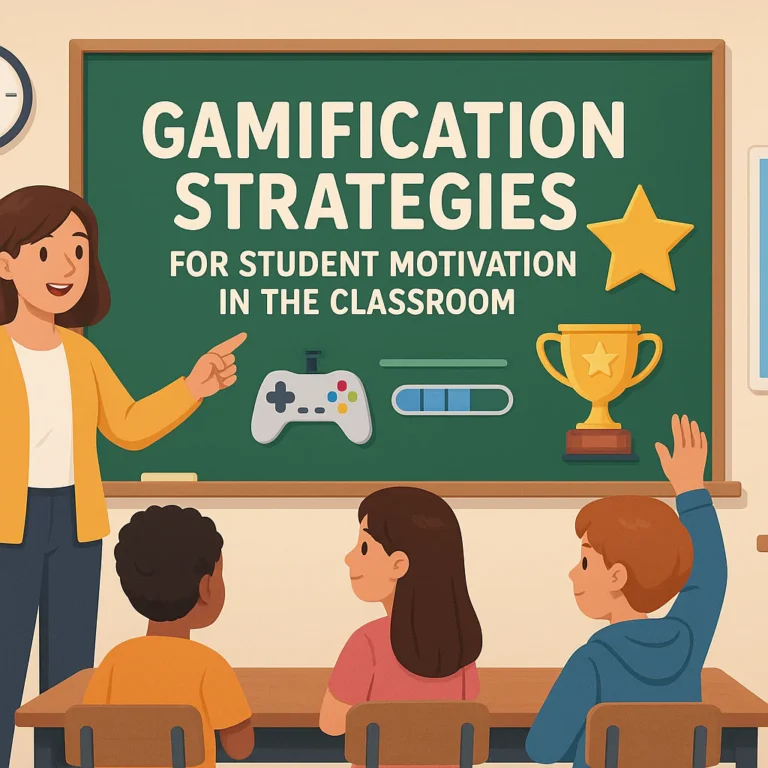
Gamification Techniques That Support Learning Goals
Useful gamification features include:
- Progress levels tied to skills
- Missions with clear objectives
- Choice of challenge path
- Immediate feedback
- Narrative context
- Retry opportunities
- Badges for demonstrated competencies
Avoid points for every movement. If the scoreboard becomes more interesting than the learning, the design has wandered off like a puppy.
💬 Feedback, Assessment, and Student Motivation
What Makes Feedback Motivating and Useful
Effective feedback is:
- Specific
- Timely enough to use
- Focused on the task or strategy
- Understandable
- Connected to the success criteria
- Followed by an opportunity to act
The best feedback often answers:
“What am I trying to do, how am I doing, and what should I try next?”
Using Formative Assessment to Adjust Instruction
If half the class misunderstands a concept, repeating the same explanation louder is not a strategy.
Use evidence to decide:
- Reteach to the whole class
- Form a targeted small group
- Provide an extension
- Change the representation
- Pair students strategically
- Assign a practice pathway
Formative assessment turns motivation into a two-way relationship: students see that their evidence changes instruction.
Student Self-Assessment and Peer Feedback
Teach students how to assess before asking them to assess.
Model:
- Read the success criteria.
- Examine an exemplar.
- Identify a strength.
- Identify a gap.
- Suggest a specific revision.
- Apply the feedback.
Peer feedback should be structured with sentence starters:
- “Your evidence is strongest when…”
- “I understood your claim because…”
- “One place to clarify the reasoning is…”
- “A question I still have is…”
Rubrics, Checklists, and Success Criteria
Rubrics motivate when they clarify quality rather than bury students under jargon.
Use:
- Three to five criteria
- Plain language
- Examples
- Student-friendly descriptors
- A space for a next step
Give the rubric before the task, refer to it during work, and let students use it for self-assessment. Cornell specifically recommends rubrics when participation is graded because they improve clarity and perceptions of fairness.
Avoiding Feedback Overload and Discouraging Comments
Ten comments can overwhelm a learner who does not know which one matters first.
Prioritize:
- One strength to preserve
- One high-impact improvement
- One next action
Avoid identity labels:
- “You are careless.”
- “You are not a math person.”
- “You never pay attention.”
Describe the work and strategy instead.
🤝 Family, School, and Community Partnerships
How Families Can Support Student Motivation
Families can help by asking:
- What are you learning?
- What part feels manageable?
- What strategy are you trying?
- What support would help?
- What progress are you proud of?
Avoid turning every evening into an interrogation about grades. Curiosity supports motivation better than constant surveillance.
Communicating With Caregivers About Progress and Bariers
Contact families with a balanced message:
- Name a strength.
- Describe the specific concern.
- Share what has already been tried.
- Ask what the family notices.
- Agree one next step.
- Set a follow-up date.
“Your child is unmotivated” is not useful communication. “Your child begins independent writing but stops after the first paragraph; we are testing a planning checklist and a short conference” gives everyone something to work with.
Connecting Classroom Learning With Community Experiences
Authentic audiences increase purpose:
- Local businesses
- Libraries
- Museums
- Environmental organizations
- Community leaders
- Families
- Younger students
- School newsletters
- Public exhibitions
A project becomes more motivating when the final product has a reader, viewer, user, or decision-maker beyond the teacher.
Building a Whole-School Culture of Motivation
School-wide consistency helps students transfer habits.
Align language around:
- Growth and improvement
- Help-seking
- Respectful challenge
- Clear expectations
- Restorative responses
- Student voice
- Accessible support
Do not create a hundred disconnected initiatives. Choose a few shared practices and implement them reliably.
🔬 What Research Says About Effective Motivation Practices
Research Questions and Evidence Standards
When reading motivation research, ask:
- Who participated?
- What age group and setting were studied?
- Was the evidence correlational or experimental?
- Were outcomes self-reported or observed?
- How long did the study last?
- Was the strategy implemented consistently?
- What limitations did the researchers identify?
The Frontiers study offers rich teacher perspectives but is qualitative and based on 42 practicing teachers. It helps us understand what teachers report doing, not prove that every reported practice causes motivation in every classroom.
The Cornell resource is a practical teaching guide rather than a single experiment. It translates established principles into instructional actions. Both are useful, but they answer different questions.
How Researchers Study Student Motivation
Common methods include:
- Student surveys
- Teacher interviews
- Classroom observation
- Attendance and completion records
- Achievement data
- Experimental interventions
- Longitudinal studies
- Student work and reflection
Each method sees part of the picture. A survey can reveal perceived value; observation can show behavior; work samples can show cognitive investment.
Insights From Student Surveys, Interviews, and Classroom Observation
Students can tell us:
- Which activities feel relevant
- Where they feel safe
- Which feedback helps
- What makes participation difficult
- Whether choices feel genuine
Teachers can tell us:
- Which strategies are feasible
- How classroom dynamics change
- What adaptations are required
Observation can reveal mismatches. A teacher may believe a choice is motivating, while students experience it as confusing because the options are not equally clear.
Use multiple sources before changing a major practice.
Where Research Findings and Classroom Realities Converge
The Frontiers study found broad convergence between teachers’ practices and motivational design principles:
- Competence through appropriate challenge and feedback
- Autonomy through choice and decision-making
- Relevance and interest
- Mastery and understanding
- Relatedness and belonging
Cornell’s guidance converges on:
- Clear outcomes
- Explicit expectations
- Meaningful choice
- Early success
- Fair assessments
- Active learning
- Regular feedback
- Supportive classrooms
That agreement gives us a strong core: make learning meaningful, achievable, socially safe, and visible.
Where Motivational Theory Does Not Fully Match Practice
The most notable difference concerns rewards and competition. Teachers use them because they can produce visible short-term changes. Research cautions that controlling rewards may weaken autonomy or intrinsic interest in some conditions.
Both perspectives can be true:
- A token may help establish a routine.
- The same token may become the only reason a student participates.
- A competition may energize a willing class.
- The same competition may silence students who fear public failure.
Use rewards as a narrow tool, not a classroom philosophy.
Limitations, Equity Considerations, and Directions for Future Research
Motivation research can underepresent:
- Students with disabilities
- Multilingual learners
- Older adolescents
- Students facing poverty or discrimination
- Online and hybrid settings
- Cultural differences in participation and achievement
Strategies should be tested against student voice and local evidence. If a practice “works” on average but excludes a group of students, it needs redesign.
📋 How to Measure Student Motivation and Engagement
Observable Indicators of Motivation
Look for:
- Persistence after difficulty
- Strategic help-seking
- Revision
- Question quality
- Voluntary elaboration
- Transfer to new problems
- Collaboration
- Self-monitoring
- Attendance and timely re-entry after absence
Do not count only visible enthusiasm. Deep concentration can look quiet.
Student Motivation Surveys and Reflection Prompts
Use short surveys with specific items:
Rate 1–5:
- I understand why this learning matters.
- I know what successful work looks like.
- I can ask for help safely.
- I have at least one meaningful choice.
- I can see how I am improving.
- The level of challenge helps me learn.
Add open questions:
- Which activity helped you learn most?
- What made participation easier?
- What made it harder?
- What would you change?
- What is one goal for next week?
Tracking Attendance, Participation, Persistence, and Work Completion
Track patterns, not labels.
| Evidence | Question |
|---|---|
| Work completion | Which task features predict stopping? |
| Attendance | Are absences linked to particular classes or assessments? |
| Participation | Are students participating through varied modes? |
| Revision | Do students use feedback? |
| Help-seking | Do students ask specific questions? |
| Persistence | What happens after an error? |
Data should trigger inquiry, not punishment.
Using Student Voice Without Turning Motivation Into a Score
Student voice is not a popularity contest. Ask students what helps them learn, then explain which changes are possible and why.
Close the loop:
“You told us group roles were unclear. We are testing assigned roles for two weeks and will review whether collaboration improves.”
Students become more motivated when their feedback has visible consequences.
A Practical Classroom Motivation Improvement Cycle
- Notice: Identify a pattern.
- Ask: Gather student perspectives.
- Choose: Select one high-leverage change.
- Implement: Use it consistently.
- Measure: Review work, behavior, and student feedback.
- Refine: Keep, adapt, or stop the strategy.
- Share: Explain the learning to students.
Do not change five variables at once. If everything changes, you cannot tell what helped.
🧰 Ready-to-Use Tools, Templates, and Classroom Examples
Student Interest and Learning-Preference Inventory
Ask:
- What topics do you enjoy outside school?
- What is something you can teach someone else?
- Which assignments help you think best?
- What makes it easier to start difficult work?
- What kind of feedback helps you improve?
- What is one goal you have for this class?
Use the answers responsibly. Interest is an invitation, not a permanent label.
Motivation Barrier Diagnostic
Have students select the statement that best fits:
- I do not see why this matters.
- I understand the goal but do not know how to start.
- I know how to start but the task feels too difficult.
- I can do the task but find it repetitive.
- I am worried about making mistakes publicly.
- I need a quieter or more accessible way to work.
- Something outside class is affecting my focus.
Then match the intervention to the barrier rather than handing everyone the same reward.
Goal-Setting Conference Questions
Use a five-minute conference:
- What are you working toward?
- What evidence shows your current position?
- What is one achievable next step?
- Which strategy will you use?
- What support do you need?
- When will we review progress?
Write the goal in observable language:
“I will support each claim with two relevant pieces of evidence and explain the connection.”
Choice Board and Project Menu Examples
For a persuasive communication unit, offer:
- A letter to a decision-maker
- A podcast episode
- An editorial
- An infographic with a written rationale
- A short public-service video
Keep constant:
- Claim
- Evidence
- Reasoning
- Audience awareness
- Revision
- Citation
Vary:
- Format
- Topic
- Research route
- Presentation method
Weekly Progress Reflection Template
This week I learned:
A strategy that helped:
A challenge I encountered:
Evidence of improvement:
My next step:
Support I will request:
Review responses quickly and respond to patterns. A reflection students believe no one reads becomes another worksheet with better manners.
Teacher Language Swaps That Encourage Autonomy
- Replace “You have to” with “The goal is…, and here are your options.”
- Replace “You are wrong” with “That answer does not fit the evidence yet; let’s examine the reasoning.”
- Replace “Try harder” with “Which strategy will you change?”
- Replace “Everyone else finished” with “Show me where the process became difficult.”
- Replace “This is easy” with “This is learnable, and we will break it into steps.”
Sample Motivational Lesson Plan
Topic: Evaluating online sources
Learning goal: Students will judge whether a source supports a claim using evidence of authority, currency, purpose, and relevance.
- Hook: Display two conflicting headlines.
- Prediction: Students vote privately on which source they trust.
- Relevance: Connect source evaluation to social media, research, and civic decisions.
- Model: Analyze one source aloud.
- Guided practice: Teams evaluate a second source using a checklist.
- Choice: Students select one source from a teacher-curated set.
- Application: Write a recommendation for a defined audience.
- Feedback: Peer review focuses on evidence and reasoning.
- Reflection: Students identify which credibility signal changed their judgment.
This lesson supports relevance, autonomy, competence, collaboration, critical thinking, and self-regulation without needing a single glitter cannon.
🚫 Common Mistakes That Reduce Student Motivation
Relying on Entertainment Without Meaningful Learning
A funny video can start attention. It cannot carry a lesson by itself.
Ask:
- What learning behavior does this activity support?
- What will students be able to do afterward?
- How will I know they learned it?
Using Praise That Fels Vague or Insincere
Students deserve accurate recognition. Praise a visible action, decision, or improvement.
Giving Students Choice Without Enough Structure
Choice requires clear boundaries, criteria, examples, and support. Freedom without structure often feels like abandonment.
Confusing Compliance With Genuine Engagement
Quiet students may be thinking. Talkative students may be performing. Use work samples, explanations, revision, and reflection to assess engagement.
Comparing Students Publicly
Public ranking can motivate a few students while discouraging many others. Celebrate individual progress and shared improvement.
Ignoring Cultural, Emotional, and Learning Differences
A strategy that works for one group may create barriers for another. Ask, observe, adjust, and preserve dignity.
🗓️ A 30-Day Plan to Improve Student Motivation
Week 1: Learn What Your Students Value and Need
- Give a brief interest survey.
- Review work for patterns of avoidance and persistence.
- Greet students by name.
- Ask one private check-in question.
- Clarify one learning goal and success criteria.
Week 2: Increase Relevance, Autonomy, and Classroom Belonging
- Add one real-world lesson opening.
- Offer two meaningful choices.
- Establish mistake-friendly discussion norms.
- Use one collaborative routine with defined roles.
- Explain why an upcoming task matters.
Week 3: Improve Feedback, Challenge, and Student Ownership
- Replace vague praise with strategy-focused feedback.
- Add one scaffolded first success.
- Teach a self-assessment routine.
- Hold short goal conferences.
- Let students revise one important piece of work.
Week 4: Review Evidence and Refine Your Approach
- Repeat the motivation survey.
- Compare work completion and quality.
- Ask students what changed.
- Identify which strategy helped which group.
- Keep one routine, revise one, and discontinue one that produced little benefit.
A Simple Teacher Reflection Checklist
- Did students understand the purpose?
- Was the first step accessible?
- Did the task require meaningful thinking?
- Did students have appropriate choice?
- Did my feedback identify a next action?
- Did every student have a safe way to participate?
- Did I notice progress beyond grades?
- What will I change tomorrow?
❓ Frequently Asked Questions About Improving Student Motivation
What Are the Most Effective Strategies Teachers Can Use to Increase Student Motivation?
The strongest combination is usually:
- Build respectful relationships.
- Make learning relevant.
- Set clear and achievable goals.
- Provide meaningful choice.
- Scaffold challenging work.
- Give actionable feedback.
- Teach self-regulation.
- Recognize progress.
- Create psychological safety.
No single strategy works for every student or every task. The Frontiers study found nine broad practice themes, while Cornell emphasizes alignment among learning outcomes, activities, assessments, environment, and teaching strategies.
Why does a combined approach work better?
Motivation depends on several conditions. Relevance without competence creates frustration. Choice without structure creates confusion. Challenge without safety creates avoidance. Combine the conditions, then measure what changes.
How Can Teachers Create a Classroom Environment That Encourages Student Engagement?
Create a classroom where students know:
- What they are learning
- Why it matters
- How to begin
- What quality looks like
- How to ask for help
- That mistakes can be revised
- That their contributions are respected
Use predictable routines, inclusive participation structures, clear expectations, and frequent feedback. Cornell recommends explaining participation, revisiting expectations, and creating early opportunities for success.
What is the fastest environmental improvement?
Make the next lesson’s purpose and first step unmistakably clear. Confusion often looks like disengagement.
How Does Goal Setting Help Improve Student Motivation in the Classroom?
Goals give effort direction and make progress visible. Effective goals support motivation when they are:
- Specific
- Meaningful
- Challenging but reachable
- Monitored over time
- Connected to feedback
- Reviewed by the student
Should goals focus on grades?
Grades may be part of a goal, but skill goals are usually more actionable:
“I will explain how each piece of evidence supports my claim.”
Students can control the strategy, practice, and revision more directly than they can control every factor influencing a final grade.
What Role Does Student Choice Play in Increasing Motivation and Participation?
Choice supports autonomy and can increase relevance. It works best when students choose among clearly defined options that address the same learning goal.
What if students choose the easiest option?
Design options with comparable rigor and use a rubric that evaluates the intended skill. Teach students to justify their selection. Choice should change the route, not remove the learning.
How Can Teachers Motivate Students Who Are Struggling Academically?
First identify the barrier: missing knowledge, unclear directions, low confidence, anxiety, inaccessible materials, or low perceived value.
Then:
- Start with what the student can do.
- Break the task into steps.
- Model a strategy.
- Provide guided practice.
- Offer a reachable success.
- Give specific feedback.
- Let the student revise.
- Track improvement.
Avoid lowering expectations without adding support. Students need dignity, challenge, and a credible path to success.
Which Teaching Methods Are Most Effective for Improving Student Engagement?
Active learning, inquiry, collaborative learning, problem-based learning, explicit instruction followed by application, and formative assessment can all support engagement when aligned with the learning goal.
Is lecture always demotivating?
No. A concise, well-structured explanation can build competence. Lecture becomes less effective when students have no opportunity to retrieve, apply, question, discuss, or receive feedback.
How Can Positive Feedback and Rewards Support Student Motivation and Classroom Success?
Positive feedback supports motivation when it is specific, honest, and connected to strategy, effort, improvement, or contribution.
Rewards can support a routine or recognize progress, but use them cautiously. Avoid making prizes, points, or competition the main reason students learn. The Frontiers study found that rewards were common in teacher reports but also the area most in tension with motivation research.
What should teachers say instead of “Good job”?
Try:
- “You revised your claim after checking the evidence.”
- “Your diagram now shows the relationship between the two processes.”
- “You used a second strategy when the first one failed.”
- “Your question helped the group notice an assumption.”
How Can Teachers Tell Whether a Motivation Strategy Is Working?
Use multiple forms of evidence:
- Student reflections
- Work completion
- Quality of explanations
- Persistence after errors
- Help-seking
- Revision
- Attendance
- Participation through varied formats
- Short student surveys
How long should teachers test a strategy?
Use it consistently for a reasonable period, often two to four weeks, while watching for immediate barriers. Change one major variable at a time so you can interpret the evidence.
How Should Teachers Motivate Students Without Relying on Rewards?
Focus on the conditions that sustain autonomous motivation:
- Relevance
- Meaningful choice
- Competence
- Belonging
- Clear goals
- Useful feedback
- Student responsibility
- Authentic audiences
Recognition and encouragement still matter. The difference is that they communicate learning and progress rather than purchasing compliance.
What Should Teachers Do When a Motivation Strategy Fails?
Treat failure as data.
Ask:
- Was the task relevant to this group?
- Was the first step clear?
- Was the challenge appropriate?
- Did students have enough background knowledge?
- Did the choice create confusion?
- Was the participation format accessible?
- Did students understand the purpose?
- What did students say about the experience?
Then revise one element and try again. Motivation strategies are not buttons; they are design decisions made in context.